






First impressions: well-made on a budget
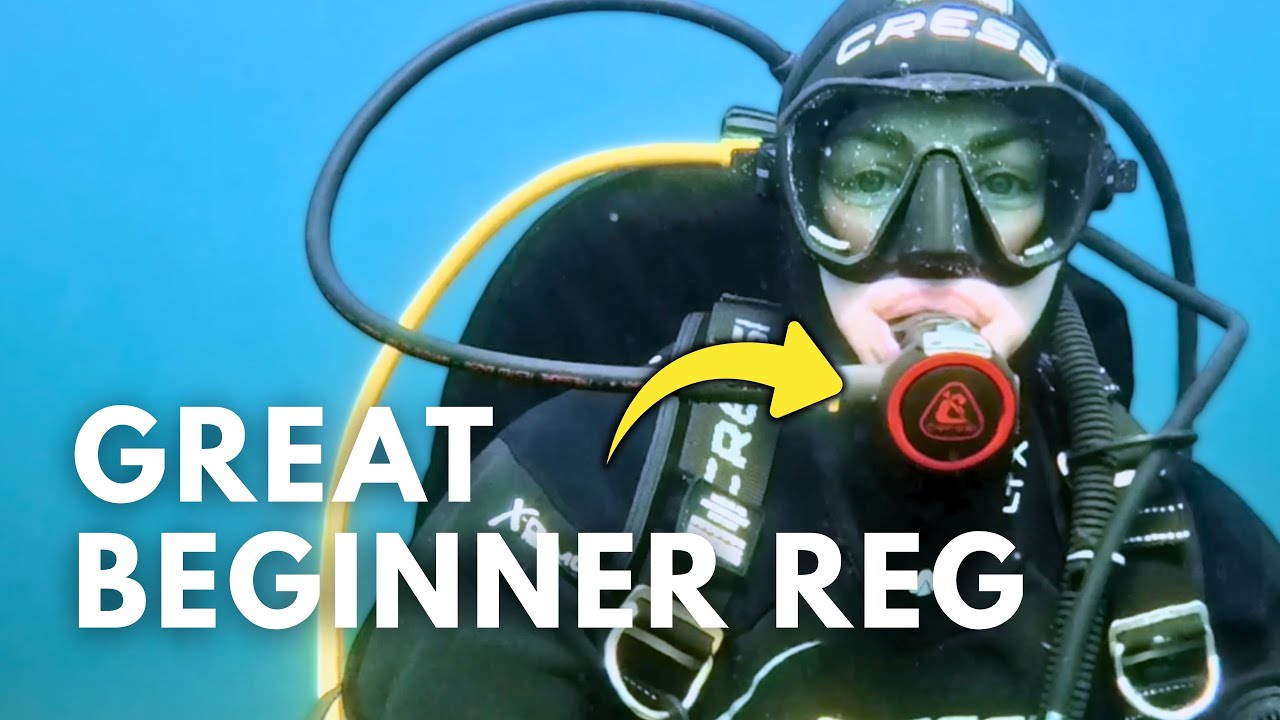
Right out of the box, the Cressi AC5 + Zen regulator feels well-made for its price range. The chrome-plated first stage looks and feels durable, while the Zen second stage stands out for its colors and how light it is.
We were also diving with a Zen octopus to complete the regulator set, providing identifiable red/yellow colors when diving with others.
Hose ports are thoughtfully angled. The included hoses are standard rubber—not braided—which is typical at this price point.
Servicing is easy and straightforward. The tool-free bayonet design on the second stage is rare in this price bracket and makes field cleaning a breeze.
Cressi’s reputation for delivering good-quality gear at affordable prices seems entirely justified here.
Test results: real-world diving experience
We tested the AC5 + Zen in:
- Cold Danish waters (around 46–50 F/7–10 C)
- Warm waters in Turkey
- A mix of calm conditions and mild currents
- Depths from shallow recreational dives to deeper recreational profiles
How did the regulator perform? We’ll break it down here.
Breathing performance

Breathing is smooth and reliable in all positions, with fairly consistent airflow whether upright, horizontal, or inverted. Even in colder water, there’s no noticeable breathing resistance.
The AC5 is not a balanced first stage, which means it’s both easier and cheaper to service. It could also mean that breathing can require more effort when tank pressure decreases. But, after about a dozen dives with the AC5 and Zen, breathing remains smooth toward the end of dives.
The chrome-plated brass first stage and durable polymer second stage held up well during testing, with no corrosion or mechanical issues after repeated use.
Cold-water use
The AC5 + Zen handled cold-water dives well during our tests with no free-flow or freezing issues, even in 46–50 F (8 to 10 C) temperatures.
However, divers planning regular cold-water use should keep in mind that the AC5 first stage is not environmentally sealed, which can be a factor in more extreme conditions or for ice diving.
No tools, no fuss
On one dive, the Zen second stage began to breathe wet—some moisture was getting sucked in with the air when inhaling. That happens sometimes when salt or particles prevent seals from closing.
Fortunately, the bayonet-style, tool-free opening means you can quickly disassemble, rinse, and reassemble the second stage right on the dive boat.
After that, the Zen continued to perform without further issues for the remainder of the dives. This kind of easy field maintenance is a big plus for recreational divers, especially when on a liveaboard or out at sea on a dive boat.
Comfort

The Zen second stage’s lightweight design really shines here. It significantly reduced jaw fatigue—even after multiple dives in a day. Heavier second stages require more mouth muscles to hang on to it, so the lightweight Zen is nice.
The compact, lightweight and ergonomic design of the Zen second stage makes it easy to maintain and comfortable on consecutive multi-dive days, which makes it especially appealing for liveaboard trips.
Hose routing
The angled ports make hose routing simple for both traditional and long hose setups. Both testers were wearing drysuits, which presented no problems setting up the suit’s inflation hose.
Regulator comparison
Compared to higher-priced regulators, the AC5 + Zen lacks advanced adjustability and fine-tuning but delivers dependable performance for recreational diving at a much more accessible price.
If you’re looking at the Cressi AC5 + Zen but want to explore similar options, the Mares Prestige 15X, Aqualung Calypso, and ScubaPro MK2 EVO/R105 are strong contenders in the same price range.
The Mares Prestige 15X features a balanced diaphragm first stage, making it better suited for cold water than unbalanced piston designs like the AC5. It delivers consistent airflow and greater freeze resistance.
The Aqualung Calypso is slightly more expensive. It uses an unbalanced piston, just like the AC5, and is lightweight and travel-friendly, though less ideal for cold water.
If you’re diving in colder waters regularly, the ScubaPro MK2 EVO/R105 is a more robust option. It’s still a piston design, but features enhanced internal freeze protection for reliable cold-water performance.
Accessories

The regulator comes standard with rubber hoses and a comfortable mouthpiece. Some divers may wish to upgrade to braided hoses or use a longer LP hose for alternate air or long hose setups.
Price/Quality Ratio
A standout for its price, the AC5 + Zen combines practical performance with thoughtful features. It’s ideal for newer divers or experienced recreational divers who want solid performance without investing in a high-end rig.
Do we recommend the Cressi AC5 + Zen?

Yes—if you’re a recreational diver looking for a dependable, budget-friendly regulator with a focus on comfort. While it’s not built for extreme cold or technical diving, the lightweight Zen second stage, solid performance, and ease of use make it a strong choice for general diving—especially on multi-dive days or dive trips.
Specs & Features
| Valve | DIN or yoke |
|---|---|
| First stage | (AC5) Unbalanced piston design; chrome-plated brass body |
| Second stage | (Zen) Compact, lightweight polymer with Venturi lever |
| Ports | One high-pressure (HP) port; four low-pressure (LP) ports angled for optimal routing |
| Max Working Pressure | 300 bar/3000 psi |
| Weight | Approximately 30 ounces (850 g) combined |
 Take a moment to look at this.