


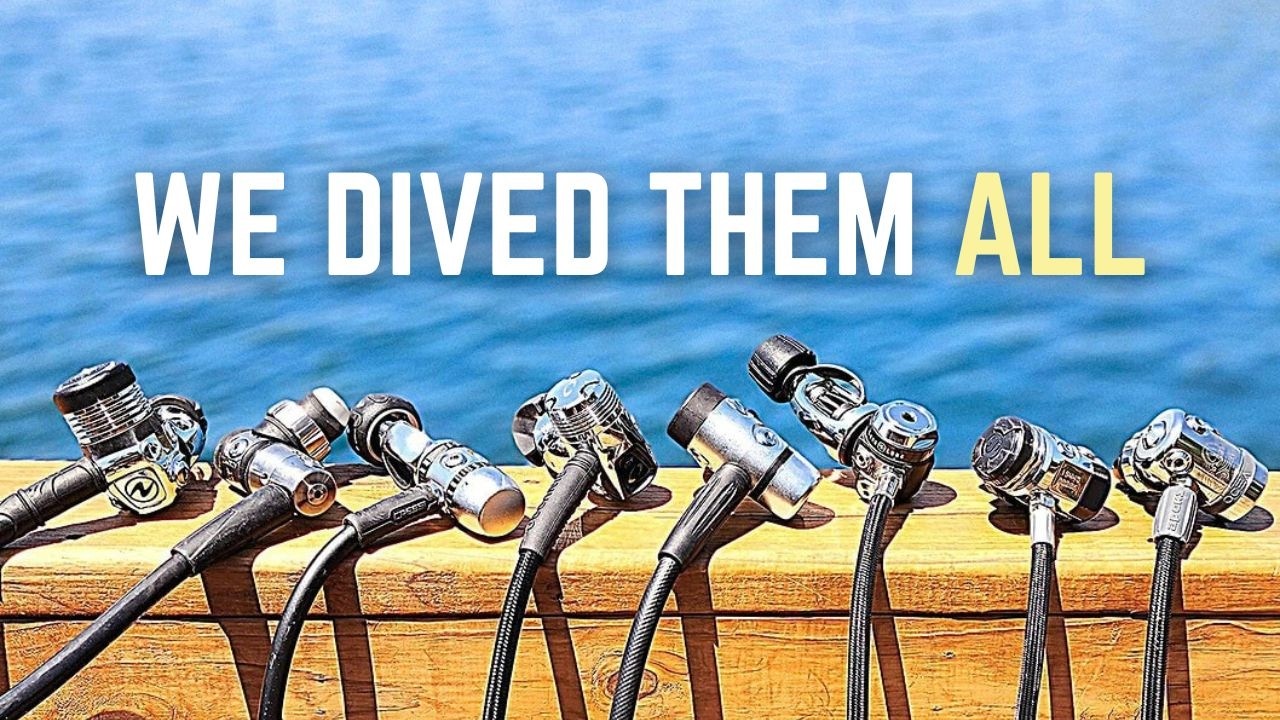


Choosing the right scuba regulator can be overwhelming. There are dozens of models across wildly different price points, and the technical specs can feel like a foreign language if you are new to buying your own gear, especially for the first time.
At DIVEIN, our review team has spent over 50 combined years diving with regulators from every major brand. For this guide, we tested 15+ regulators in real dive conditions, including open-water reef dives, cold-water quarry sessions, and deep dives below 100 feet (30 m). We evaluated each regulator on breathing effort at depth, free-flow resistance, comfort during long dives, build quality, and value for money. Below you will find our top picks for 2026, followed by a detailed buyer’s guide.


What to look for when buying scuba regulators
There’s a lot to consider when it comes to buying a scuba regulator. Where you’ll be diving; if the water is primarily cold or warm; how deep you plan to dive; if it will be in saltwater or freshwater; if you’ll be traveling a lot; the price; and the type of diving you’ll do will all impact your purchase decision.
Here are a few factors you should consider:
Do you need a DIN or yoke?
It all depends on where you’re diving, as standard usage of each type is highly geographical. If you’re primarily diving in places where the tanks are set up for yoke regulators, of course that’s what you’ll want. If, however, you encounter more DIN valve tanks, go for a DIN regulator.
Not sure of the difference? It’s pretty simple—just remember that “DIN screws in,” which means that a DIN valve regulator screws into a threaded opening on a tank. A yoke (or international) regulator, on the other hand, sits over the tank’s opening valve.
A DIN regulator has an internal O-ring inside the scuba regulator itself, which is visible when you remove the dust cap. That way, when you screw the regulator into the tank, the O-ring is snugly inside. On a yoke setup, the O-ring is seated in the opening of the tank.
Of note here is that yoke tanks are more common. Most rental tanks, especially aluminum, are yoke, as are most tanks found in the Caribbean and other popular dive destinations.
Proponents of DIN argue, however, that because the O-ring is placed in a less superficial position, there is an added level of safety because O-rings won’t blow. For this reason, DIN is becoming increasingly popular as more and more dive shops offer both DIN and yoke tanks. The overwhelming majority of steel tanks use a DIN setup.
So, when deciding, consider whether you will be diving primarily with steel tanks or whether you’ll be traveling to destinations that favor the yoke setup.
Can I use a DIN regulator on a yoke tank?


You certainly can. You’ll just need a converter. Look for one that is solidly made from durable materials and looks like it can take a few knocks. For DIN divers, a converter is an essential bit of gear that should never leave your dive bag when you’re on a scuba vacation.
We like this converter from manufacturer Aqua DIN.


Can I use a yoke regulator on a DIN tank?
Yes, but you need to know what you’re doing, as there’s a safety issue here. A DIN tank is rated to 300 bar (4353 psi) and a yoke tank is rated to 232 bar (3364 psi). If you fill a DIN tank to 300 bar and use a yoke regulator on it, you could end up in a world of hurt or worse.
To adapt a yoke regulator to a DIN tank, you’ll insert a “plug” with the dimensions of the yoke valve into the DIN opening on the tank. This does not change the working pressure of the tank. Most high-pressure DIN tanks are filled beyond the safe limit for yoke regulators, so your yoke regulator may not be able to handle the higher pressure.
By nature, the yoke tank contains an external O-ring. This O-ring can rupture when subjected to too much pressure—best case scenario, it ruptures on the boat while you are setting up. Worst case scenario, it bursts underwater. By using a high-pressure tank that’s filled to 300 bar, you’re taking a chance on that O-ring rupturing.
If you don’t have a high-pressure tank filled to over 232 bar (3364 psi) limit you should be fine. But remember, most high-pressure tanks are filled beyond the limit of a yoke-fitted regulator. So, if you use a yoke regulator on a DIN tank, make sure the pressure of the tank does not exceed 232 bar (3364 psi) before you add the yoke to the tank.
Once you’ve checked, all you need is an insert and an allen key. Any dive center worth its salt (water) will have these readily available. But it’s never a bad idea to have a few extra with you just in case. You can pick them up here.
We generally do not recommend this except for the most experienced divers. It can be a safety issue that novice divers may not have the experience to recognize.
Pro Tip: Use your old mask box to store your inserts, allen keys, scuba multi-tool, spare fin straps, and all those bits and pieces the well-equipped diver never leaves the shore without.
How much do you want to spend?
Here at DIVEIN, we classify regulators into three categories: budget, mid-range, and high-end.
We consider any regulator up to or around $350 as a budget or entry-level regulator. Don’t let the cost fool you though— a great many of them are still really good regulators. What you will run into, however, is that most of these are unbalanced. This means you will feel a much harder breathing effort as you descend deeper.
Also, many of these regulators are not environmentally sealed, making them a poor choice for cold-water diving. Think about where you dive most frequently. If you plan to plunge into cold water anytime soon, choose a higher-level regulator.
Our mid-range category runs from roughly $350 to $799. You can find a mixture between budget and high-end in this category. Some will be balanced but not environmentally sealed and vice versa. Some might not perform quite as well as the high-performance regulators, but if you only dive on vacation, this category would be a good fit. Ultimately, this price range hits the sweet spot for the vast majority of divers.
Our high-end, or high-performance, category contains those regulators that cost above $799. These are high-performance regulators that are both environmentally sealed and balanced. You will find these regulators on the tanks of instructors, divemasters, advanced divers that dive deep, and technical divers.
Not everybody in the diving world needs a regulator that meets these specifications. However, if you anticipate advancing through your diving career, or if you just seek the highest level of machinery, it might not be a bad idea to start with—or upgrade to—one of these regulators.
Will you be diving in cold or warm water?
If you’ll be diving in water that’s significantly colder than 57 F (14 C), you need a scuba regulator that’s fit for that purpose. In fact, diving in water below 60 F (15 C) is considered cold-water diving. Make sure that it is environmentally sealed, or at the very least look for a regulator that has been built to isolate the internal mechanism.
All diaphragm-driven regulators, by their nature, are environmentally sealed. This level of protection ensures the first stage will not freeze up because no contact occurs between the surrounding water and the internal parts.
But surely, 60 F doesn’t seem that cold. So why would this be an issue? Due to the way first-stage regulators move highly pressurized air at incredibly high speeds, the regulators routinely drop in temperature up to 20 degrees. This happens because the air pressure moving from the tank into the first stage drops, thus rapidly expanding the air and cooling it, regardless of the water temperature. Warm water, however, acts as an insulator, while cold water doesn’t give the regulator a chance to warm up.
A metal second stage is also better for cold-water diving because metal has more thermal conductivity than plastic. Any scuba regulator is fine for use in warm water.
Consider ease of breathing
This one is a no-brainer, since your regulator needs to be easy to breathe from without undue resistance. Because you can’t always test out a regulator before you buy it, choose trusted brands. Check scuba forums for advice and reviews, and follow the information you find in trusted publications, such as this one.
On the whole, piston-driven regulators are a simpler design, and allow a larger volume of air to reach the second stage. Recently, a spate of inexpensive knock-off regulators have made their way into the marketplace. Are these unknown brands tested to meet stringent safety standards?Our advice here is to steer clear—if the price seems too good to be true, it probably is.
What does balanced or unbalanced mean?
A balanced regulator neither assists nor resists the flow of air; it breathes the same under all conditions. This matters when it comes to external conditions including the amount of gas remaining in a tank, depth, or breathing rate. At lower tank pressures, an unbalanced regulator may exhibit increased resistance.
While balanced scuba regulators really start to perform on dives deeper than 130 feet (40 m), you’ll already feel the difference as you approach 100 feet (30 m). So, if you’re planning to dive mostly in deeper water, choose a balanced reg.
Note that internal, more complicated mechanisms are to thank for making a regulator “balanced,” which will make the reg more expensive.
What gasses will I be using?
Most regulators are safe to use with EANx (enriched air nitrox) up to 40% once you are trained and certified. Becoming EANx certified allows a diver to calculate the best mix possible and maximum operating depth.
For decompression diving, you should consider the regulator’s compatibility with gasses including higher-percentage oxygen, and you will certainly need to choose a DIN regulator. Again, this level of diving requires more certification training and vast experience prior to undertaking.
How many ports does a regulator have?

Scuba regulator weight
The first stage should have a minimum of three low-pressure ports (sometimes marked as MP or medium pressure) for recreational diving— one for the primary second stage, one for the alternate, and one for the inflator hose. If you dive with a drysuit, you will need an additional port so you can add air to your suit from the tank.
There will also be a high-pressure port (marked HP) for the Submersible Pressure Gauge (SPG)/console. Contrary to the belief of some, you still need an SPG when diving with a transmitter and air-integrated computer.


Are you purchasing a scuba regulator for a child?
If you’re traveling for diving a lot, you’ll want a regulator that doesn’t take up a lot of your weight allowance. Look for regs that have been specifically designed for travel.
Keep in mind, though, that weight is at the bottom of this list for a reason. Don’t pick a regulator that won’t perform as you expect it to or one that won’t meet your needs based purely on size or weight. The heaviest scuba regulators on the market today weigh in at just over 2 pounds (0.9 kg), while the lightest weigh just under 16 oz (.45 kg), and 16 oz in checked luggage won’t make or break your holiday.
Look at other equipment to lighten your load. Besides, you should probably carry your most important piece of lifesaving equipment in your carry-on baggage.
If so, look for a regulator with slightly shorter hoses and a mouthpiece that will fit comfortably in smaller mouths. For children’s scuba regulators, our top picks are the Scubapro MK2 EVO or the Aqualung Mikron. Both of these trustworthy regulators come in DIN and yoke versions and include an R195 second stage, or Mikron second stage, respectively.
Most divers spend $300–$800 on a quality regulator setup. Entry-level models are affordable and reliable for recreational diving, while higher-end regulators offer smoother breathing, better cold-water performance, and more durability. The right choice depends on how often you dive and the conditions you expect.
A balanced regulator delivers consistent airflow regardless of tank pressure or depth, making it easier to breathe throughout the dive. Unbalanced regulators are simpler and more affordable but can feel slightly harder to breathe as tank pressure drops. Most modern regulators are balanced for improved performance.
Most manufacturers recommend servicing your regulator once a year or every 100 dives, whichever comes first. Regular maintenance ensures safe performance, especially if you dive frequently or in harsh conditions like saltwater or cold environments.
Some regulators are designed for both, but not all are suitable for cold water. Cold-water regulators have environmental sealing and anti-freeze features to prevent free-flow in low temperatures. If you plan to dive in cold conditions, make sure your regulator is rated for it.
DIN regulators screw directly into the tank valve, creating a more secure seal and handling higher pressures. Yoke (A-clamp) regulators attach over the valve and are more common at resorts and rental shops. DIN is preferred for technical and cold-water diving, while yoke is more convenient for travel.
Yes, an octopus is a standard safety feature. It provides a backup air source for emergencies, allowing you to share air with a buddy if needed. Most regulator setups include one, and it’s required by most dive operators.
A well-maintained regulator can last 10–20 years or more. Longevity depends on how often it’s used, how well it’s serviced, and the conditions it’s exposed to. Regular servicing and proper storage significantly extend its lifespan.
Beginners can start by renting, but buying your own regulator offers better fit, familiarity, and hygiene. If you plan to dive regularly, owning a regulator quickly becomes worthwhile and improves comfort and confidence underwater.
 Take a moment to look at this.



Where would you rank the new Apeks OCEA ? :)
As Number 6 in this guide as Most Innovative. This is a great regulator, and made from recycled parts & bioplastics. Plus the facilities of Apex where this is manufactured is solar-powered, making this one of the most environmentally friendly regulators.
What do you thing of Mares Abbys?
Hi David,
We haven’t tested the Mares Abbys so I don’t have that many comments on it. Hope you can find a suitable regulator on the list above.
I am planning a few dives tours while on a cruise ship and want to bring as little equipment as possible. Does anyone know if it is acceptable to only bring the 2nd stage of your regulator and connect to their 1stage? So I only have the mouth piece and hose.
Hi Kevin,
I don’t think you’ll be allowed to do so, and it’s not advisable either. Most manufacturers recommend you use the same first and second stage.
Yes, that would do, but if you go below 45 I suggest you get an environmentally sealed regulator.
Yes, that would do, but if you go below 45 I suggest you get a environmentally sealed regulator.
Hi,
Is the Cressi AC2/ XS2 regulator okay to use for diving in waters between 45-50 degress F?
Hello,
Could you please tell me which regulator you’d recommend me? Apex xtx50 or Mares ultra 72x?
What is your opinion on them? Thank you.
Hi Tom,
Yes, the Oceanic Apph 10 and SPX first stage will serve you well at depts of 110 feet. No issue there.
Question in regards to the Oceanic Alpha 10 with SPX First Stage: I dive at depths from 90 – 110 or a little deeper occasionally, would the “Oceanic Alpha”
be a good choice?
All regulators have an exhaust valve, but the placement might be what you should look at. Usually, they have expelled air coming out just below the mouthpiece and with the exhaust valve “pointing” both ways. This way the air can get out no matter your face direction. So, to get a different air stream when breathing out, look for the placement of the exhaust valve and see if you can fin done that will suite your needs.
I have not been diving in many years but am considering getting back into it’s a port this time. In the past I dove with commercial regulators which I have dove with in ice covered waters and to some extreme depths. This time I want into something VERY light as an hour with thos commercial regs left you with hours of fatigue after using them, but I still want it to be balanced, and easy breathing. My guess is I most likely will never go down to 100ft any longer but more around the 50ft max zone with the option of going a bit deeper. I would also desire it to handle some harsh environments such as that of heavier salty and suspended sands as I found in the Persian gulf and Red Sea. I am not worried about the cost, just the reliability and it meeting my desired needs.
Thank you fo
Hi David,
Did you look at the guide, as I’m sure it’ll answer most of these questions :)
Hello,
I don’t like to take all the different Regulators from different dive centers in my mouth. Especially now since Covid 19.
I’m thinking about to buy at least the mouth part but i guess I have to buy a complete regulator?
How can I decide which one is the perfect regulator for me?
I would want to use it for dive centers i Asia. That means warm water and they’re using INT norm?
What is the minimum I have to buy?
What is the best I can get?
What brand normally prof. diver would use? Is there common brand they’re usually using?
Many thanks for AOWD
really useful info. Any more regs with exhaust valve? I hate having bubbles in my face when looking at anything
Hi Tercier,
Diving with a mobile denture, that’s a really good question!
Quick follow up question: You say “regulator while snorkeling”, and this is a bit contradictory. A regulator is used for scuba diving and a snorkel is used for snorkeling.
As for the regulator, any regulator will do. You might need to consider changing the mouthpiece in order to find a fitting one, but this is possible on any of the above regulators. The issue is not as much the fit of the regulator, but wheater the mobile denture will follow out once the regulator is removed (or accidentally pulled out). I can’t find any mouthpieces that are made solely for this purpose, so you need to try your way through a few of the once available. Check out this guide: https://build.divein.com/guide/regulator-mouthpiece/
For snorkeling, it’s not always possible to change the mouthpiece. Here I’d suggest you look into a full face snorkel mask: https://build.divein.com/full-face-snorkel-mask/
I hope this gives a bit of calcification.
Could you please advice me what regulator do you recommend for someone who is an excellent diver with a mobile denture?
With a normal regulator she lost her denture whilst snorkeling.
Thank you very much.
Yes, sure will. Have fun with it :)
Hi..i used to be at 90-110ft of depth..does Mk2+R295 suites my needs?
Hi Ahmed,
It wasn’t been part of the regs we’ve tested, so I can’t really say. I’ve tried it once, and it was good, but that was not part of a test but just a regular fun dive. I’ve only heard good things said about it, but more than that I can’t give you :) Hope it’ll help a bit.
Hi Torben ,
How about the mares instinct 15X ?
Hi Ahmed,
The Mares Rover is a really good regulator for any beginner diver.You’ll get a great one. It’s reliable, sturdy, hard-working, breathes well. All in all a great reg.
Hi there, iam a new advanced open water.. Would you help me choose between mares rover reg. Or prestige x15 reg. ? With some comparison.
Also computers mares puck pro & suunto zoop novo ?
Thank you for your assist
Can I simply just say what a comfort to find somebody that actually understands what they are talking about. Great guide!