


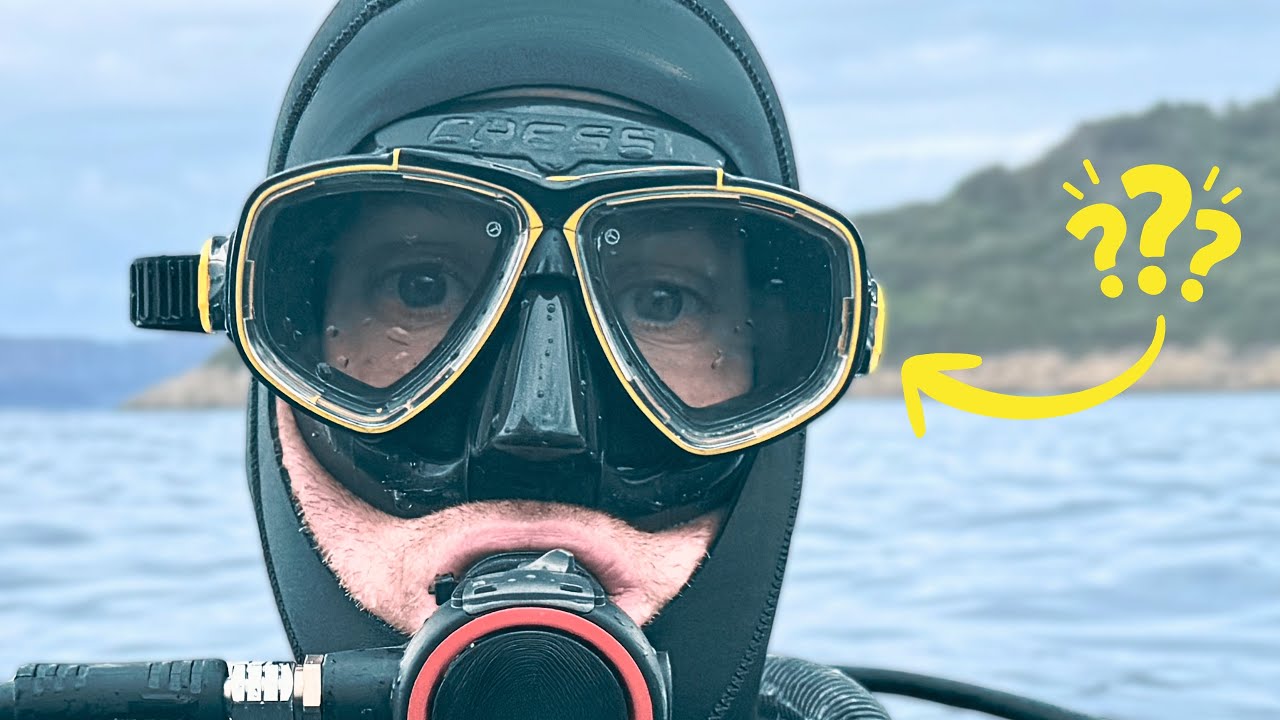


 Cressi is a leader in the dive industry when it comes to masks, and continually strives to find new and innovative ways to make the good even better. The Cressi Prisma incorporates a unique anti-fog system that not only sets it apart visually but also changes how it feels to wear.
First impressions: unique design choices

At first glance, the Cressi Prisma looks pretty similar to most dual-lens masks. Upon closer inspection, I can see some unique design features, and the Prisma is, in fact, part of a new generation of masks recently released by Cressi which has what they call the “Fog-Stop system.”
This includes inner membranes and a heat exchanger, aka six “ridges” behind the eyes, and an internal rim around the eye sockets and the nose as well (inner membranes). I’ll explain in more detail later what this is exactly and what it means for divers.
Some masks can have a sticky plastic feel to them which can be hard on my hair, but the Prisma’s skirt feels soft and of high grade upon first inspection. Buckles are small and are attached quite far forward on the frame itself, so the skirt is under it. I think this will help to keep my hairline separate from the side of the mask and stop it getting tangled.
Fog-Stop system—fact or fairytale?

The Prisma’s standout feature is what Cressi calls its Fog-Stop system. The Prisma combats common mask-fogging problems in three key ways:
- Extended eye sockets: The silicone within the mask, around the eye sockets, extends into the mask, individually framing each eye.
- Closed-off nose pocket: Any air, moisture, or heat generated by the nose is reduced by keeping it separate from the internal mask area.
- Six external ridges: On the external part of the skirt, above the eyebrows, there are six ridges. These provide an extra surface area to act as heat exchangers between the space inside and outside the mask.


Together, these features are meant to help the temperature inside and outside the mask stay as similar as possible, which will reduce condensation and fogging.
In theory that all makes sense, but does it make any difference in the water? I did prepare the mask with just some toothpaste and good old saliva, and I can attest that I didn’t have fogging issues.
I don’t know really if this was to do with all the extra features or just because it didn’t fog like many masks would. We’ve got more dives planned to give the Fog-Stop system a more in-depth assessment.
Cressi comfort

Similar to the Cressi Z2, the Prisma seems to be made from the same velvety-soft silicone, which is very comfortable on the face. The buckles are connected to flexible points on the frame, allowing for precise strap tension without tugging on the silicone itself.
The soft silicone also gives the mask a relatively foldable design, making it a practical choice for divers who value portability. Additionally, Cressi offers negative and positive optical lenses (full lenses or bifocals) to cater to a wide range of vision requirements.

I did find that with the extra silicone around the eye and nose pockets, I felt a bit like a horse looking through blinkers. I have always preferred single-frame masks, and thought that dual-lens can be somewhat constrictive, though that could just be a personal preference.
Price/Quality Ratio
For $100, I do think that the Cressi Prisma mask is fairly priced, especially if you’re looking for a dual-lens mask that’s corrective-lens compatible. The fact that the Prisma remains fog-free without any treatment is another appealing feature.
Do we recommend the Cressi Prisma mask?

If you like dual-lens masks, then yes, we definitely recommend the Cressi Prisma. It’s also great for those who need a prescription mask. Coupled with Cressi’s own line of optics, adding corrective lenses is relatively easy. The excess silicone was a bit restrictive for looking out—and in—but the fog-free nature of the mask right out-of-the-box largely compensated for that.
Specs & Features
| Dimensions | 4.75 x 4.25 inch (122 x 115 mm) |
|---|---|
| Framed or frameless | Framed |
| Lens (dual or single) | Dual |
| Skirt | Silicone |
| Lens treatment | Clear |
| Volume | No info |
| Corrective lens compatible | Yes |
 Take a moment to look at this.