




First impressions: solid and easy-to-read

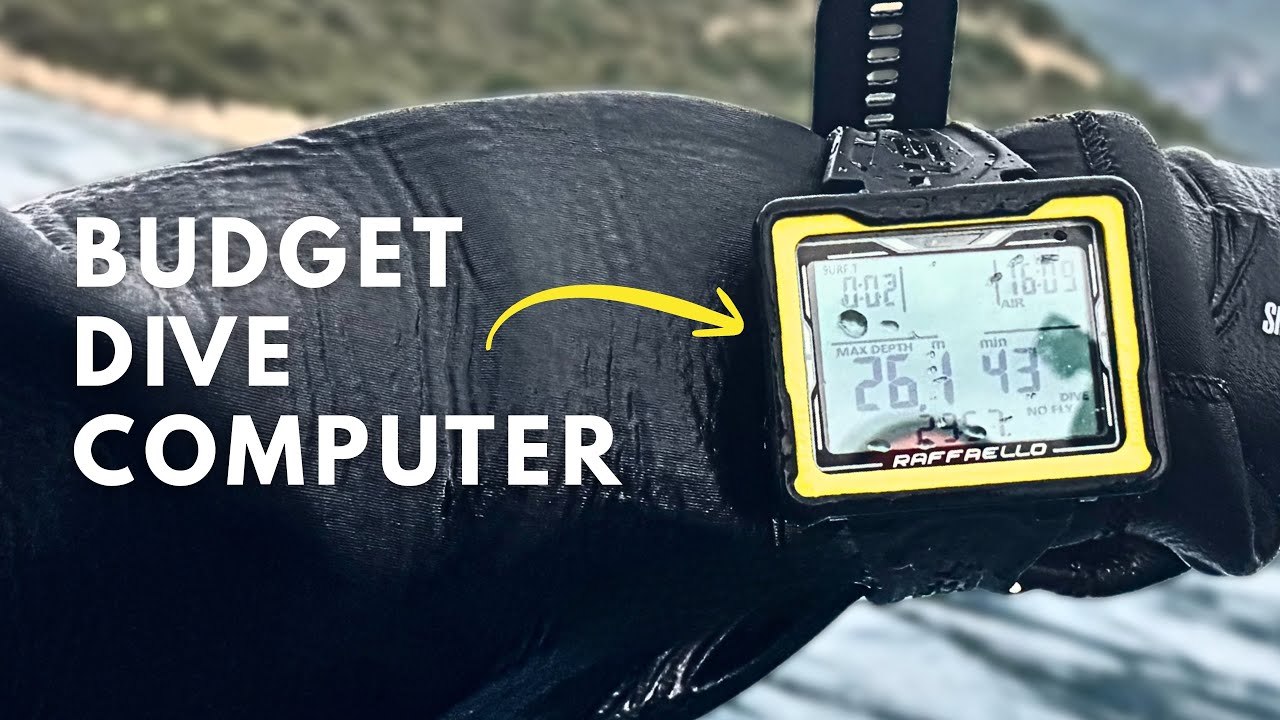
Unboxing the Cressi Raffaello, the first thing we noticed was its rectangular screen and solid build. With the battery pre-installed, the Raffaello is ready to dive out-of-the-box. The display is large and clear. It features a monochrome screen with a contrasting display, so the numbers and data are clear and crisp to read. An illuminating backlight is another nice feature.
The simple non-color screen goes hand-in-hand with its simple two-button menu interface, which makes it pretty easy to navigate around and change settings. The buttons are push-in, and seem as though they’ll work well even with gloves on.
Dive Modes

The Cressi Raffaello dive computer has three main modes: dive (air/nitrox), free dive, and gauge. In air/nitrox mode (the standard scuba diving program), the Raffaello uses Cressi’s RGBM algorithm to manage your dive profile.
This means that you can’t change conservatism. The Raffaello handles nitrox mixes from 21% up to 50% on the primary gas, and can switch to two additional gases up to 99% oxygen for accelerated decompression stops. You can engage or disengage at a deep stop. So, although the Raffaello is lacking the more advanced dive modes, decompression diving is possible.
The limitations of the algorithm do make this computer more attractive to instructors or students, who always want to err on the side of safety. The Rafaello can also be reset through a function called “T.ERASE,” (tissue erase instrument reset), which is useful for dive schools and dive shop rentals.

I noticed that Cressi allows you to use T.ERASE in freediving mode after a dive, and seems to treat it as a separate entity. Since freediving is strongly discouraged after scuba diving, I wasn’t too keen about this feature. However, I do understand that if this is a rental computer, and someone entirely different is using it, then this feature could come in handy.
Compass integration

Given the price point of this computer, I was not expecting to see a digital compass. Many comparable dive computers, such as Suunto Zoop Novo or Shearwater Tern, don’t have a digital compass. The compass is not tilt-compensated (you need to hold the unit level), but that’s common for digital compasses in this price range.
Having a compass within your computer means one less thing to spend money on and to bring on your dive. Given the backlighting of the screen, we found that the compass was easy to use and see at all times. Considering many dive computers under $400 lack any compass, this expands the Raffaello’s utility greatly.
Robust build

At first glance, the Cressi Raffaello is perhaps not the sexiest dive computer, especially when compared to the latest array of smart dive computers, such as Garmin G1 or Suunto Ocean. However, if that’s not one of your decision-making factors, then the Raffaello’s simple-yet-strong design makes it a reliable, robust choice.

Despite its slight20 mm thickness, the Cressi Raffaello is an impressively strong and durable dive computer.
Its reinforced case is made from nano-reinforced polymer, which means it can take the daily bumps of the dive boat without issue.
→ The screen is made from hardened borosilicate, avoiding unwanted scratches.
→ Both together give it a depth rating of 395 feet (120 m).
→ Raffaello’s durable battery is a standard 3V coin cell you find in watches. This means that it can last several years, and it’s also cheap and user-replaceable.
Accessories
Cressi Bluetooth interface for Raffaello computer


Although the computer’s logbook lacks bluetooth connectivity, the manual states that it can store up to 80 hours in the computer itself. The Raffaello does offer the option to be connected with a Bluetooth interface to transfer your dive data from the computer to an app on your phone. We did not, however, get the chance to test the interface device.
Price/Quality Ratio

The Cressi Raffaello is definitely a good value dive computer. I liked its flat design, which meant it could still feature a reasonably sized screen without being overly chunky or uncomfortable to wear.
Another plus for the Raffaello is the inclusion of a compass, which is not something you often see in low-to-mid-range dive computers. If you like the idea of a larger screen, but don’t want something as chunky as the Cressi Donatello or want something at a lower price point than the Shearwater Peregrine, the Raffaello is the perfect middle ground.
Do we recommend the Cressi Raffaello dive computer?
The Cressi Raffaello is a great computer for those first learning to dive or who want to buy their own. The only real downside is its lesser logbook capabilities, but for many this won’t even be an issue. The Raffaello doesn’t have any of the more complex dive modes, but, given its reasonable price tag and target audience, it’s a great choice for most recreational divers.
Specs & Features
| Display type | Wrist |
|---|---|
| Display size | 1.5 x 2 inch (3.8 x 5 cm) |
| Screen resolution | Monochrome matrix, backlight |
| Battery | CR2450 user-replaceable battery |
| Size | 1.5 x 2 x 1 inch (3.8 x 5 x 2 cm) |
| Depth rating | 395 feet (120 m) |
| Number of gases | three |
| Dive modes | Air, gauge, free |
| Alarms | Audible only |
| Dive log capabilities | 80 hours (air/gauge/nitrox) + 32 hours (free). |
| Transmitter compatible | No |
| Weight | 0.26 pounds (118 g) |
| Number of buttons | Two |
| Compass | Yes |
| Wrist straps | Long plastic |
 Take a moment to look at this.