


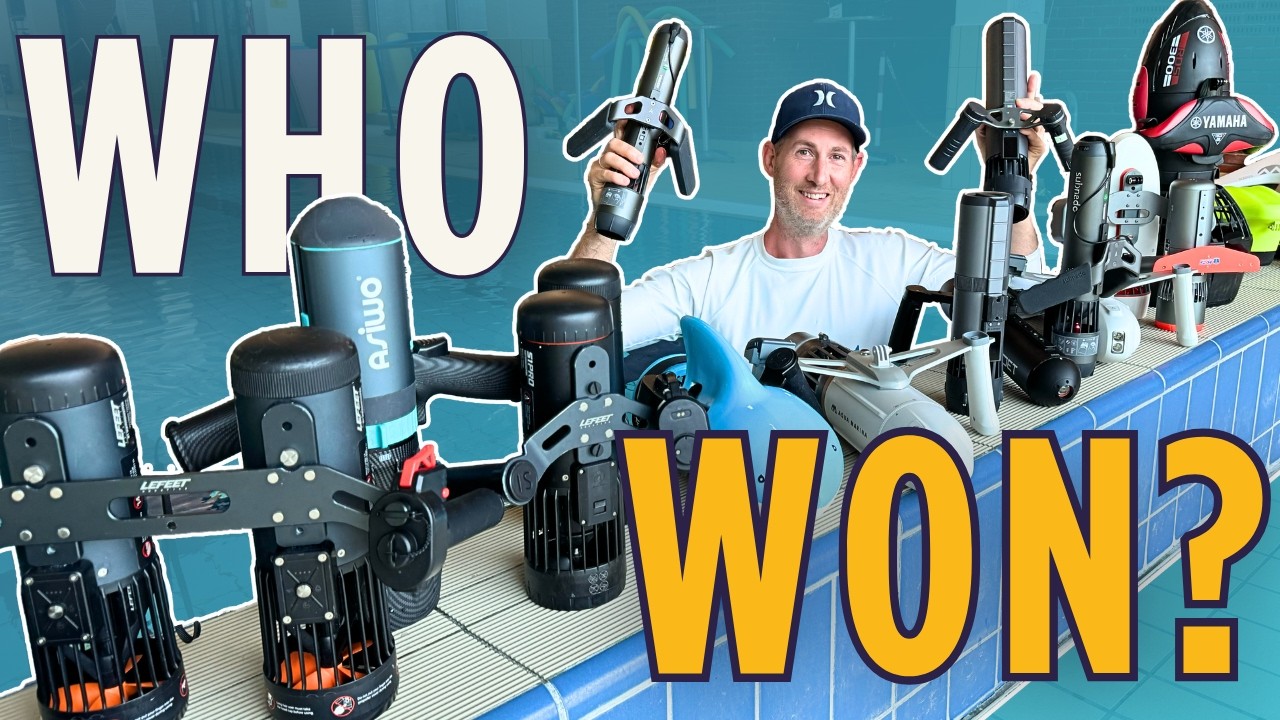


Underwater scooters, also known as diver propulsion vehicles (DPVs), vary widely in performance, and not all models deliver the speed, battery life, or control you expect once you are in the water. With options ranging from compact, travel-friendly units to high-powered DPVs, differences in thrust, buoyancy, and runtime can significantly impact real-world usability.
To identify the best options, our team of three certified divers, with more than 40 years of combined experience, tested these underwater scooters side-by-side in a 25-meter pool, measuring speed over controlled distances and running batteries to full depletion. We then took the top performers into open water to evaluate buoyancy handling, noise levels, and usability at depth. Based on this hands-on testing, we selected the best underwater scooters for 2026, from entry-level models to high-performance DPVs.
How we test


 The LEFEET P1 Lite offers a compact, travel-friendly sea scooter experience without the bulk or price tag of high-end DPVs. In our tests, it delivered strong speed and intuitive control in snorkeling and scuba conditions, making it a solid choice for snorkelers and play in the pool


Underwater Scooter Buyer’s Guide
Even the most affordable underwater scooter costs around $500, so let’s go over a few things to keep in mind before making your choice.
What type of diving do you do?
Before buying any piece of diving equipment, you must consider what exactly you want to use it for—if it’s up to the job, too advanced, or not advanced enough. The same applies to underwater scooters, so ask yourself a few questions before making the investment:
- How deep do you want to go?
- Do you want to travel with the scooter? If so you’ll need a more lightweight model.
- Is variable speed important, and how fast do you want to go?
- How important is a long battery life?
- How often will you use it and is the charge time quick enough?
Or, perhaps you want children to use it and the scooter needs to be easy to control. Each underwater scooter features unique specs and features, so once you have answered the above questions, you’ll be better equipped to make the right choice.
Maintenance
Despite their compact size, scooters are a technologically advanced piece of equipment that you should never attempt to fix or alter on your own. Make sure your new scooter comes with a warranty and, if something goes wrong, that you’re within a reasonable distance of a reputable service facility.
To avoid any damage to your scooter, read the instruction manual carefully before use and make sure it’s assembled correctly. Look after it properly by rinsing it with fresh water after each dive.
If your battery is of the lead-acid variety, there will be required routine maintenance. This is why Lithium-ion types are preferable, although considerably more expensive.
Buoyancy
All scooters offer different buoyancy options and you’ll need to know which type and whether this will suit your needs. Some scooters are set to negative or positive buoyancy; others offer a buoyancy control system, allowing you to change it yourself.
Negatively buoyant scooters could be a problem for beginners because they will pull the diver down, and it’s easy to lose a scooter if you drop it. For that reason alone, a lanyard is a sensible option when using these scooters.
Equally problematic, positively buoyant scooters can pull you up and may make the scooter harder to control. More expensive models offer buoyancy adjustments, allowing you to maintain neutral buoyancy easily. This option also makes it easier to change from salt- to fresh water.
Battery and run time
How long a scooter will last underwater varies widely from around 30 minutes to several hours. Models with shorter run times, like the Waydoo Subnado, are really aimed at short, shallow dives and snorkeling. If you go this route, it’s probably worth having at least a spare battery or two. Longer running-scooters, such as the LEFEET P1 or P1 XR can last between 60 and 90 minutes, respectively
Top tips for diving with a scooter
Zooming around underwater for the first time? Before you jump in, enlist the help of an instructor who is licensed to teach DPV diving and read over these helpful tips.
Take a course or practice in the pool
Although they’re undoubtedly a lot of fun, you should take underwater scooters seriously whether you’re snorkeling or bringing one on an advanced dive. If it’s the latter, especially, make sure you get some thorough training before diving with a scooter so that you are fully prepared.
Even if you only intend to use the scooter on shallow dives or while snorkeling, it’s a good idea to try it out and get used to it in the pool before hitting open water.
Complete a safety check
The standard pre-dive safety check applies while diving with an underwater scooter, too—you just need to add in a few DPV-specifics.
Pre-dive checks include both generic safety measures, which apply to all scooters, as well as model-specific checks. Make sure you know exactly what you should be looking for before taking your scooter on a dive—you don’t want to end up with a power failure or a flooded scooter mid-dive.
Stay streamlined
Make sure that you, and your equipment, stay streamlined. The last thing you want is a loose hose dangling on top of your scooter, as this is not only dangerous but may also damage your expensive equipment.
How much distance you can cover while using an underwater scooter has a lot to do with your trim. Make sure you’re weighted correctly and have the right amount of air in your BCD. An over-inflated jacket will create drag, resulting in a higher air consumption and a shorter dive time.
Finally, make sure that you’re positioned correctly behind your scooter with your arms slightly bent. Straight arms will cause back issues, and holding the scooter too close to your body will make you cold from the water flow.
Equalizing
Equalizing with one hand can be a problem when you’re using scooters that require both hands to stay stable. Before deciding which to buy, make sure you know the best equalizing techniques that suit the scooter you’re considering. Hands-free (on a lanyard or leash), or single-hand-operated DPVs do not have with this issue.
Underwater scooters FAQs
Most underwater scooters travel between 2 to 4 mph (3 to 6.5 km/h), with high-end diver propulsion vehicles (DPVs) reaching closer to 5 mph (8 km/h). Entry-level models for snorkeling and casual use tend to be slower, while advanced scuba DPVs prioritize stronger thrust to handle currents and deeper dives.
Underwater scooters are worth it if you want to cover more distance, conserve energy, or enhance your dive experience. They are especially valuable for photographers, technical divers, and anyone exploring large reefs or wrecks. For casual snorkelers, they are more of a fun luxury than a necessity.
Depth ratings vary widely depending on the model. Recreational underwater scooters are typically rated for 30 to 100 feet (10 to 30 meters), while advanced DPVs used in scuba diving can reach depths of 200 feet (60 meters) or more. Always stay within the manufacturer’s stated depth limit to avoid damage or failure.
Battery life usually ranges from 30 minutes to 2 hours, depending on speed settings, rider weight, and water conditions. Lower speeds extend runtime, while maximum power drains the battery faster. Premium models often feature swappable batteries for longer dive sessions.
You can travel with some underwater scooters, but lithium-ion batteries are heavily regulated. Most airlines require batteries to be carried in hand luggage, and larger batteries may not be allowed at all. Always check airline policies and battery watt-hour limits before flying.
The terms are often used interchangeably, but “underwater scooter” usually refers to consumer-friendly models for snorkeling or recreational use, while “DPV” (diver propulsion vehicle) typically describes more powerful, technical-grade units designed for scuba diving, longer ranges, and deeper depths.
Underwater scooters can be safe for kids when used under supervision and with age-appropriate models. Many manufacturers design lightweight, slower scooters specifically for children. Proper instruction, shallow water use, and safety features like automatic shutoff are key.
Underwater scooters can disturb marine life due to noise and movement, especially in quiet environments. However, reactions vary by species. Moving slowly and maintaining a respectful distance reduces the impact, and in many cases, marine life quickly returns once the scooter passes.


 Take a moment to look at this.



Do you have any recommendations for a scooter that works in current? I dive in South Florida in around 40ft of water spearfishing and lobster diving. I am looking for a scooter that can get me back to my anchored boat. I was looking at the Dive xtras blacktip but its simply way too big for me to use with all me spear fishing gear I have on me already.
Hi Joe,
For thsi the Lefeet P1 might be really good to look at. It can be attached to your legs or you can hold onto it.
Based on test, you would need 2 P1s to match them Scubajet
The Scubajet was a really good scooter, but is no longer in production.
Oh I did not know that. So I have a collector’s item :-)
As an avid underwater explorer, I can’t contain my excitement about the Lefeet S1 Pro! If you’re on the hunt for the perfect underwater scooter to elevate your diving adventures in 2023, look no further.
The Lefeet S1 Pro is not just a piece of equipment; it’s a game-changer that caters to all budget ranges. It has completely transformed the way I experience the underwater world
Hi there,
I am interested in a sea scooter that lasts 1.5 hours and has a high speed, but I don’t know the brand and the prices, which one do you recommend?, at any price not too high
Hi Leonard. There’s a difference between scooters for tech divers and those for recreational diving. I’m just back from a trip testing out two Lefeet scooters, both separately and together, in order to find out how long they last. The reason this was interesting is that they don’t cost (relatively speaking) that much compared to scooters that last as long as you’d like. Unfortunately, for speed and longevity at a reasonable price, there’s not yet the product you’re looking for. Unless you’re prepared to pay $2000 or more. For reference: on low speed, with two Lefeet working in tandem, I got around an hour (conditions will change the time).
I’m a 62 year old male who has advanced open water certification with a hundreds of dives logged. I only dive recreationally for multiple days on dive vacations we take outside the US in warm water 2X per year. I dive at various depths but mostly in the 30 to 80 feet range. I’ve taken the PADI DPV course. I have progressing muscular dystrophy which has had a big impact on my leg strength – it’s difficult to fin kick and I can only frog kick and use my arms when diving. Any current is challenging. I’m looking into DPV’s Would you please reply and comment. Thanks Mike
Hi Mike,
It looks sounds like you’re looking for help with swimming, and not one that’s for going a long distance.
So, I’m thinking that you need a smaller unit that you can bring on any dive without too much hassle.
I have two options, I’d recommend you:
The first option is the Lefeet s1 or s1 Pro. (either will do)
It’s small, but okay power. Price is fair. Easy to operate, and also a possibility to mount on the tank if you want hands free. It’s controlled via a wireless hand remote controller.
Second option: The ScubaJet. It’s small but powerful. It’s not a budget option, but you really get the full power here still in a compact unit. You need both hands to operate this one.
Both options are fly compatible, so you can bring them on your trips.
Hey, we’re looking for a scooter mostly for our pool with the kids (7-10) — something fast with good battery life. I was looking at Seablue’s Whiteshark on Amazon, a fair share of people saying it just stops working and has bad customer service. And its battery life is short (30 min). Any advice appreciated.
Here I’d recomend the Lefeet P1 or S1 Pro with the shark floatie, or the WayDoo Subnardo – the last is the best value for money in the Pool – where as the P1 has more power.
Hi there,
We’ll be testing the Scubajet next month, and will let you know. If you’re going into strong currents, you might need to go for the larger technical scooters though.
Looking for a fast scooter to handle S.E. Florida current. Any recommendations?
How about the scubajet?
Most in this list will do, but all are made for diving. Not sure if that is what you’re looking for?
We are looking for a sea scooter for our grandson to use at the lake. What would you recommend
Hi Vinay,
Sounds really great. What are you gonna use them for.
We can’t offer a price quote as we don’t sell the products.
Hii we are planning to buy 2 scooter. Pl give us price for the product.
Hi Grandma J :)
For this, you don’t want and underwater scooter, as they are meant for going to depths a 7 year old can’t handle. I’d suggest you look for a snorkeling scooter and one that is so buoyant that he can’t take it underwater.
my 7 year old is an avid swimmer and snorkeler sp? Which shall I buy for him? Would like him to pretty much stay on the surface in and to dive w/o scooter
Hi John,
I’m not sure I understand your question. What are you looking for?
It was great to see your findings on some of these dps we have developed an underwater flying helmet system and was using a Lefeet motor but for some reason or another they are not communicating with us we would ask you if you could recommend another motor similar to Lefeet in specifications Kind Regards John
Need a machine for treasure hunting,need to be able to blow sand away while snorkeling
What do you recommend for a 220lb 50 yr old male with lots of snorkel experience? I want tkk ok get this as a birthday gift. Budget is not an issue. I just want something he will enjoy and be able to use.
Yes, it’s hard to enjoy the dive when using a DPV for the first time. Will properly need some getting used to. Or use it to and from the dive site, or just for the fun of it on a dive site without anything to see.
I did a few dives with a dpv and i was disappointed because I was so focused on steering the dpv that i couldn’t really enjoy the underworld world to its fullest. Perhaps I just need a few more dives and a higher skill level with a dpv.
I feel like flying when I dive but with this it’s like being a fighter pilot.
The coolest child dream coming through! If you haven’t tried it yet Go for it!