


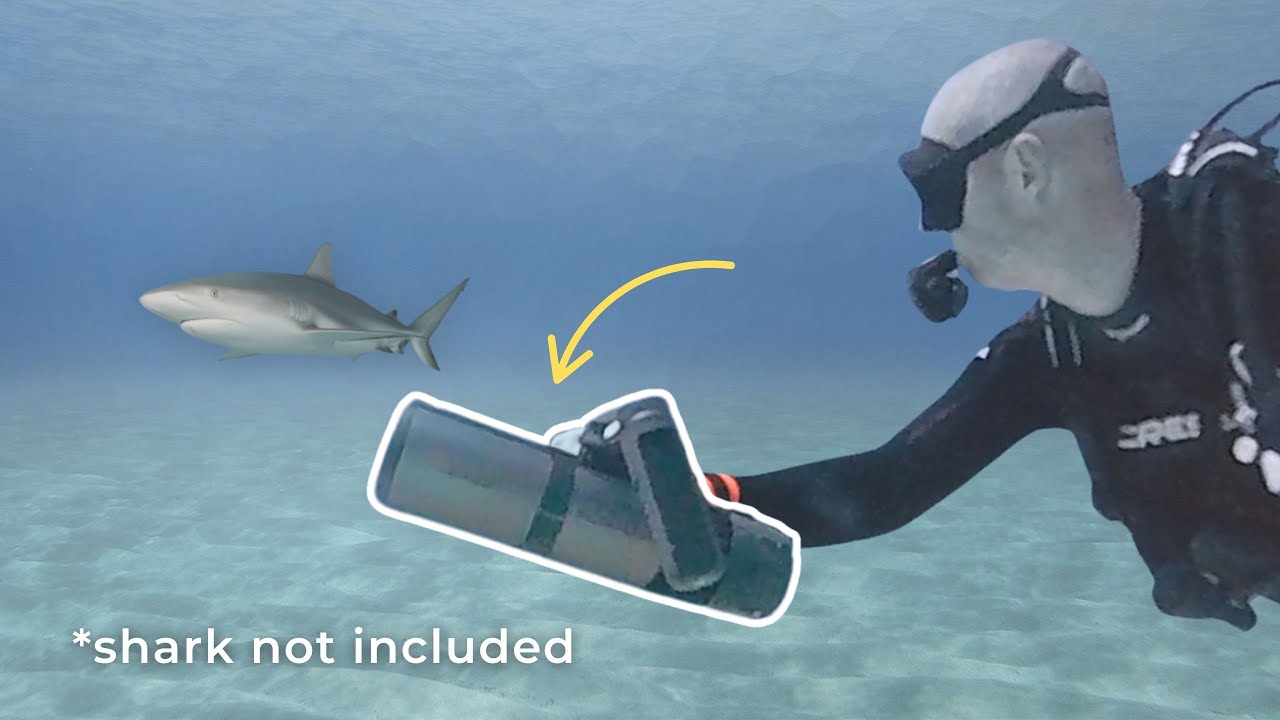


 Ideal for recreational divers, the modular LEFEET P1 underwater scooter is easy to disassemble and pack, weighing just 5.3 pounds. (2.4 kg). Plus, the battery is flight-safe so you can keep it in your carry-on.
LEFEET P1 versus P1 XR

The LEFEET P1 is a modular underwater scooter, which essentially means it can be disassembled into several smaller parts. Although this might sound a little intimidating, don’t worry—there isn’t any wiring involved. With the P1 you screw apart the handles, engine, and battery into more manageable pieces, helping spread the weight.
This modularity also means you can swap out the battery for a larger one. LEFEET refers to the extended battery model as the P1 XR, for extended range. Depending on your needs, you might find that you can really benefit from that extra power underwater.
So, what other differences are there? Well, side-by-side, the P1 XR is about 30% taller, extending the total height of 12 inches (31 cm) to 17 inches (40 cm). The standard battery is 5 inches (13 cm) long and the XR is 8.6 inches (22 cm). The engine and the handles are the same. Since both batteries must be taken in your carry-on, consider if you have room for them, with the smaller one roughly the size of a soda can and the XR comparable to a Pringles can.
Aside from size, the XR will give you an extra speed—a fifth “S” super speed. As advertised, the P1 maxes out at 2 meters/second with a runtime of 60 minutes, whereas the P1 XR can hit speeds of 2.3 m/s and will last 90 minutes. Note that during our battery tests, we got 24 minutes and 30 minutes respectively. These differences are attributable to the fact that we tested the units at top speed the entire time, whereas LEFEET’s data is 60/90 minutes of intermittent use.

During both of our battery tests, both the standard P1 and P1 XR continued for approximately 10 more minutes at a lower, energy-saving speed. On its website, LEFEET does mention that the P1 will run for 30 minutes at full speed, which aligns well with our results.

When it comes to speed, again there are some discrepancies between the company’s data and ours. We ran a range of speed tests at our local 25 yard/m pool, with a variety of configurations, including a single P1, a P1 XR, two P1s on a handrail, and two P1 XRs on a handrail.
We performed the tests with DIVEIN’s co-founder Torben, his 10-year-old son Carl, and then with Torben outfitted in full scuba gear. Each of those runs was performed three to four times to get an average. Below are our results, all in meters per second.

We attribute our slower times to several factors, including the fact that the scooter needed 3-4 seconds to get up to speed; we were in a small 25 yard/m pool; and we needed to stop short in order to not hit the wall. However it is still valuable data, and can help you better understand the speed you might achieve.
| Adult | Child | Scuba | |
|---|---|---|---|
| P1 | 1.05 m/s | 1.27 m/s | 0.63 m/s |
| P1 XR | 1.44 m/s | 1.63 m/s | 0.93 m/s |
| P1 double | 1.40 m/s | 1.59 m/s | 0.97 m/s |
| P1 XR double | 1.79 m/s | 2.08 m/s | — |
Modular design
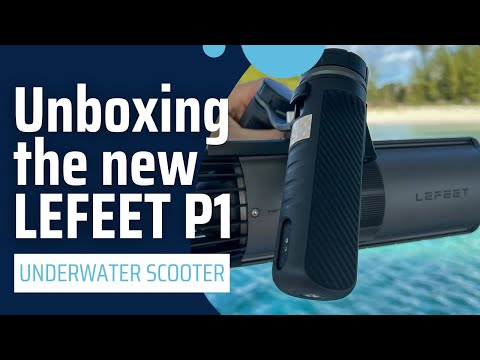
The overall look and feel of the P1 is very sleek.
What sets the LEFEET apart from the other underwater scooters on the market is its modular design. Although the S1 Pro is partially modular, the new P1 takes it to another level.
The main difference between the LEFEET S1 Pro and the P1 is that the battery compartment is completely detachable from the engine, halving it in height. The regular battery on the P1 is comparable in size to a regular soda can. It’s so modular that we even managed to fit it all into a packing cube.


With this adaptable, modular design, you can create many different configurations to suit your needs, whether by creating a single unit, double unit, or even attaching it to your stand-up paddleboard. By adding a larger battery, you’ll not only increase the maximum speed from 6.5 feet (2 m) per second to 7.5 feet (2.3 m) per second, but also the ride time from 60 minutes to 90 minutes.
Construction

The LEFEET P1 is made from a high-strength composite material, which provides excellent structural integrity and keeps it lightweight and agile in the water.
The unit and handrail are made from lightweight and sturdy anodized aluminum. A minor frustration here was that the screw attaching the handrail did wiggle, which left us feeling that we needed to tighten the screws even more. However, as soon as we were running it underwater, this became just a minor annoyance.
The LEFEET feels well-built, and you don’t have the sense of this being just another plastic toy, which has been the case with a lot of underwater scooters.
User experience

So, most importantly, what is it like to use the new LEFEET P1 and P1 XR? Well, thanks to its lightweight build and comfortable controls, using the P1 is extremely fun and very easy. We have used it for scuba diving, freediving, and snorkeling. Although not necessarily advertised as a toy, we loved seeing our kids racing and whizzing around the pool, which just confirms how easy the P1 is to use.

Assembling the LEFEET P1 is intuitive and simple, and within a minute or so you can have one unit put together and ready to use. This ease of use continues to the XR battery. Once you plug in and screw on the larger battery, you’ll see that there’s an extra gear. With the P1 XR, the top speed goes from 2m/s to 2.3m/s and the run time increases from 60 to 90 minutes.
The batteries, both standard and XR, are easy to charge with a USB-C cable. Since the handles connect remotely to the main unit, they do need to be charged separately. There is a separate magnetic cable specific to the handles, so be sure not to misplace that one. If the handles aren’t charged, you can’t connect to the main unit. We would’ve liked a failsafe, wherein we could physically connect the handles to the unit via a cable, like with the Waydoo Subnado.

An upgrade to the user experience is the addition of an OLED display. Since one regular battery will give you approximately 60 minutes of ride time—roughly equal to or longer than most recreational dives—you could argue that knowing the battery level isn’t necessarily important. But we’re human and we like to keep track of things.
The handles of the P1 have been redesigned to be more ergonomic and comfortable, and this did not go unnoticed. The handle edges are rounded and the sides are flat, which equates to a secure grip.

A lot of other underwater scooters we have tested tend to pull away from you as soon as you switch to one-handed operation. Not only is this annoying, but your wrist also starts to ache. We never had this problem with the P1. Having a spare hand meant we could equalize, turn on a torch, use a camera, and more without having to stop the scooter.
LEFEET P1 compared to S1 Pro

First, as mentioned above, the modular system and the detachable batteries are a real game-changer when it comes to charging them, swapping them out, or packing them in our hand luggage. The main unit (one engine with battery and a handle) is around 30% smaller than the S1 Pro. The P1 batteries are also TSA-approved and, weighing approximately 1.3 pounds (600 g), they aren’t a hindrance in your hand luggage.
Another notable improvement regarding the batteries is that they can be charged with a USB-C cable, which most of us have on hand. Not only is this much more convenient but cables are also much more compact than the S1 Pro bulky charger. The handles do require individual charging with a small magnetic charger.

Another upgrade with the P1 is a display on the engines, which shows the current gear/speed and indicates the remaining battery. The information is shown simply and brightly and we had no issues reading it underwater.
Not just for diving


One of the key selling points of the LEFEET P1 is its adaptability and versatility for different sports and activities. Although this review is written with scuba divers in mind, LEFEET offers a range of attachments and accessories, depending on its mode.
Tank mode, for example, is a scuba-tank mount; leg mode is a dual-thigh holster strap kit; SUP mode allows you to attach it to your stand-up paddleboard; and foil mode is meant for attaching to a foil board. If this sounds like more your style, just remember that these all require a separately purchased wireless remote as well.
Price/Quality Ratio

The LEFEET P1 is available on Amazon for just over $1000, so it’s definitely one of the priciest compact scooters we’ve ever tested. If you are considering the XR battery, then we suggest buying that outright. The P1 XR is $1300, whereas an extra XR battery is nearly $500.
In our tests, the P1 and P1 XR performed the best, with longest battery run times and the fastest speeds, so the higher price point is justified. Due in part to its modular design, the P1 is much lighter, more compact, more convenient, and more adaptable for various water activities than many of its competitors.
Do we recommend the LEFEET P1 and P1 XR?
Yes, we do recommend the LEFEET P1/P1 XR. We loved how compact and lightweight it is, and how comfortable and easy it was to handle in the water. Its modular design makes it very versatile for a range of activities, from scuba diving to stand-up paddleboarding. It did perform the longest and fastest, so if you need a scooter that packs more power, we highly recommend the P1.
Specs & Features
| Weight | 5.3 pounds (2.4 kg) & 7 pounds (3.2 kg) |
|---|---|
| Number of speeds/gears | Four or five with XR |
| Advertised top speed | 2 meters/second or 2.3 meters/second (XR) |
| Our top speed | 1.27 m/s and 1.63 m/s |
| Torben | 1.05 m/s and 1.44 m/s |
| Carl | 1.27 m/s and 1.63m/s |
| On scuba | 0.63 m/s and 0.93 m/s |
| Advertised battery time | 60 mins and 90 mins (intermittent use) |
| Our battery time at full speed | 24 mins and 30 mins |
| Carry-on safe | Yes |
 Take a moment to look at this.