




First Impressions: Power Meets Portability

Out of the box, the Sublue Navbow feels solid and well-built without being overly heavy. The dual-propeller design immediately stands out, and it’s clear this isn’t your average toy scooter. Setting it up couldn’t be easier—slot in the battery, power it on, and you’re ready to go.
Switching between speed modes is seamless, and there’s even a one-hand mode for advanced users. This is a huge plus for divers needing to equalize or adjust gear mid-use.
In terms of buoyancy, the Navbow is positively buoyant, which is great for safety and surface play but less ideal for diving. However, it comes with an additional weight that you can attach to make it neutrally buoyant underwater.
Performance Testing: Speed & Battery Life

To put the Sublue Navbow through its paces, we ran a series of timed tests in a 25-meter pool. The goal was to measure how fast the scooter could carry both an adult and a younger user across a set distance in each of its three speed modes: Free, Sport, and Turbo. Torben handled the adult testing, while Carl, our 10-year-old test diver, provided insight into how the Navbow performs with a lighter user.
Here’s what we found:
Torben’s times (25 m pool):
- Free Mode: 29 seconds (0.86 m/s)
- Sport Mode: 23 seconds (1.09 m/s)
- Turbo Mode: 19 seconds (1.32 m/s)

Carl’s times (25 m pool):
- Free Mode: 26 seconds (0.96 m/s)
- Sport Mode: 20 seconds (1.25 m/s)
- Turbo Mode: 16.1 seconds (1.55 m/s)
The Navbow felt incredibly responsive throughout the tests. Its dual-thruster design delivered smooth and powerful acceleration, making it easy to build speed quickly in Sport and Turbo modes. Even in Free mode, it moved us along at a comfortable pace for relaxed snorkeling or gentle dives.
For maneuverability, the bow-shaped design and side-mounted thrusters make a noticeable difference. The water flow is directed away from your face, so we didn’t feel like we were being blasted while riding. It’s easy to steer, and in one-hand mode, we got even more control—ideal for equalizing or managing a camera setup underwater.
Sublue Navbow vs. Sublue Vapor vs. Waydoo Subnado

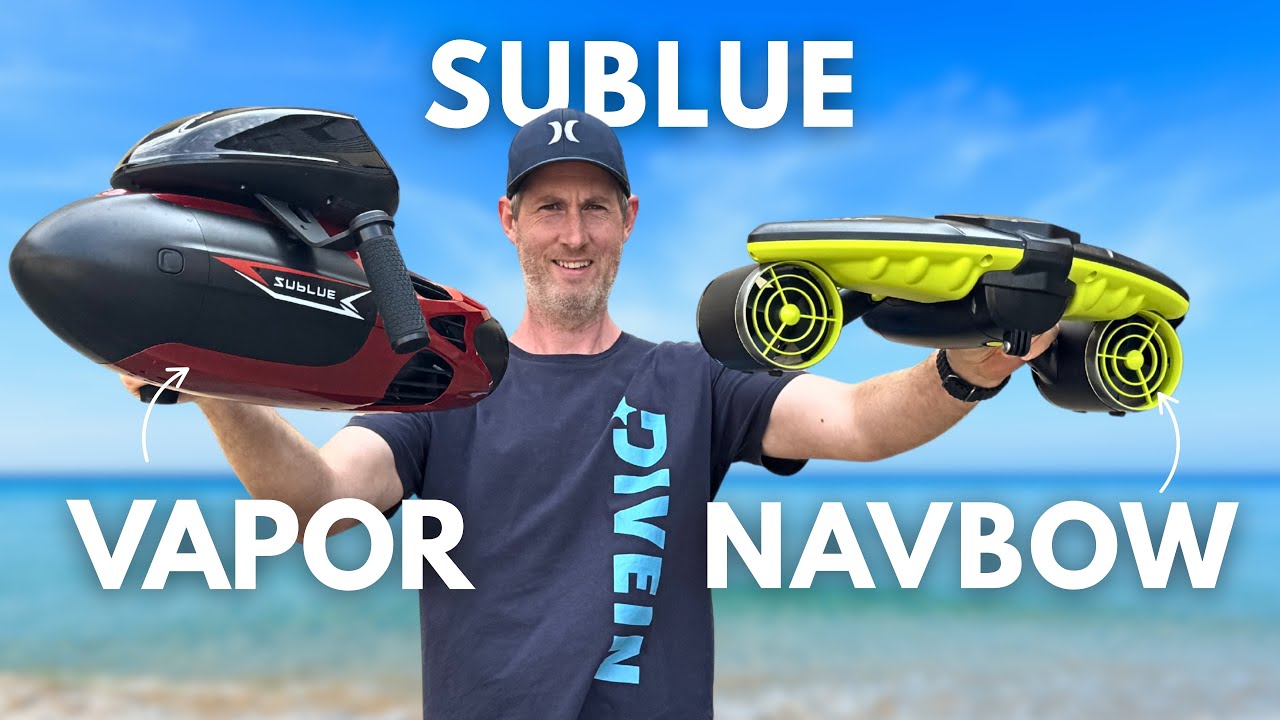
The Sublue Vapor is the Navbow’s big brother—bigger, faster, and far more powerful. In our pool tests, the Vapor left the Navbow behind, especially with the extended battery. But it’s also larger, heavier, and at a completely different price point.
If the Vapor feels like too much scooter (or too much money), the Navbow is a fantastic compromise, giving you plenty of power without breaking the bank.
Compared to the Waydoo Subnado, the Navbow sits on the other side of the spectrum. The Subnado is smaller and ultra-light for travel but lacks the thrust needed for strong currents or diving. The Navbow’s dual-propeller design gives you far more control and speed, making it the more capable option for divers and snorkelers.
Accessories: What’s in the box?

The Sublue Navbow comes packaged in a gray, high-quality styrofoam carrying case with a clever dual-opening design. Open one side, and you’ll find the charging compartment where the charger and battery are neatly stored. Flip it around, and you get access to the main unit itself.
Inside the box, you’ll find:
- 1x Navbow main unit
- 1x 158Wh battery (flight-safe)
- Charger and cable
- Neutral buoyancy weight (to help balance the scooter underwater)
- Safety strap (to secure it to your wrist)
- User manual
This setup makes it easy to keep everything organized and protected during transport. Optional accessories like an action-camera mount and spare batteries are available separately and are highly recommended if you plan on using Turbo mode often.
Price/Quality Ratio

At $999, the Navbow sits in the mid-range tier of DPVs, but it delivers where it counts. The power, usability, and feature set justify the price for frequent divers or underwater photographers who need speed and precision. For casual snorkelers, cheaper models like the Sublue WhiteShark might be enough.
Do we recommend the Sublue Navbow?

Yes—for serious users. The Navbow is ideal if you’re after speed, power, and reliability in a small form factor. It’s not the scooter for long exploratory dives unless you have extra batteries, but for short, high-performance bursts or filming sessions, it’s one of the best DPVs we’ve tested.
Specs & Features
| Weight | 9.91 lbs. (4.5 kg) |
|---|---|
| Speed modes | Free, Sport, Turbo |
| Advertised top speed | 4.47 mph (2 m/s) |
| Our top speed | Torben 1.32 m/s; Carl: 1.55 m/s |
| Maximum depth | 130 feet (40 m) |
| Advertised battery time | Up to 60 minutes (varies by mode) |
| Our battery time | 20 minutes at full speed |
| Charge time | Approximately 3.5 hours |
| Battery | 158Wh, flight-safe (carry-on only) |
 Take a moment to look at this.