


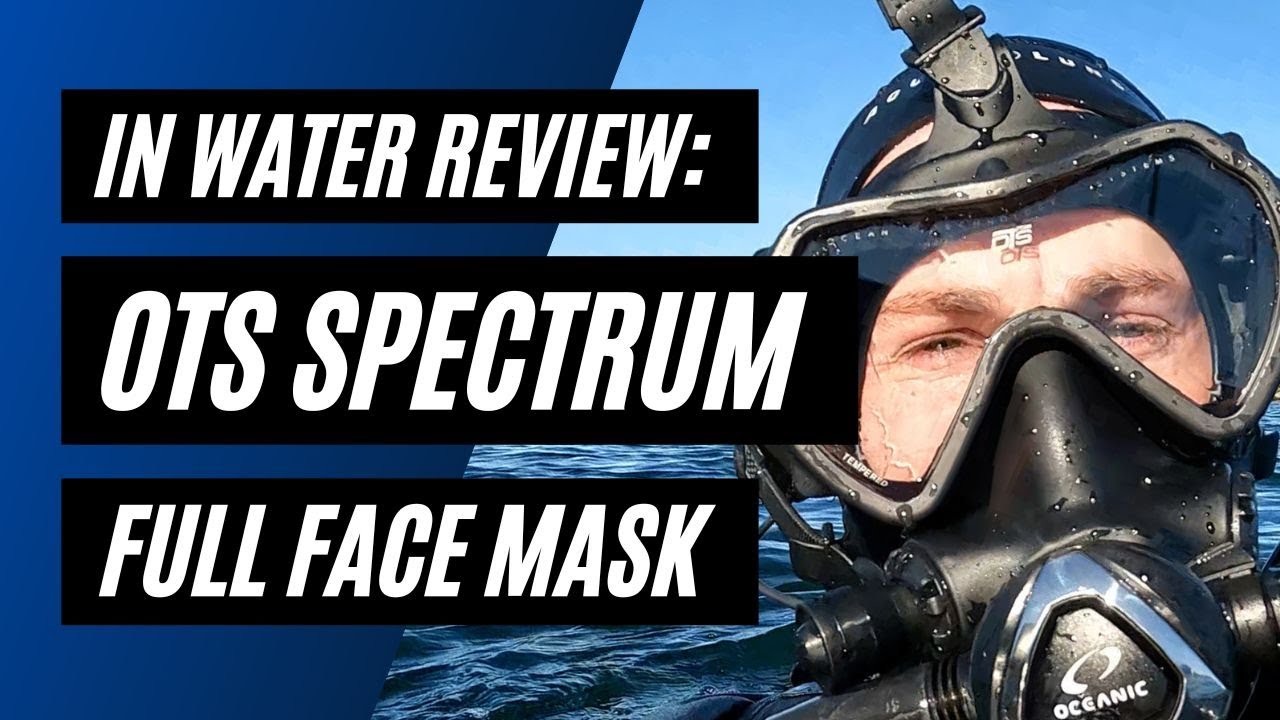


 The Spectrum is a bare-bones full face mask for scuba diving with solid design qualities. It’s the less expensive model from Ocean Technology Systems (OTS), mainly because there’s no
 Review of the OTS Spectrum Full Face Scuba Mask

After a few scuba sessions with the latest OTS Spectrum Full Face Diving Mask, we found it to be a solid product. As the name itself suggests, this mask is designed for a wider spectrum of divers. With a price that’s significantly lower than OTS’ premium FFM, the Guardian, the Spectrum provides an experience that’s closer to a traditional dive mask too.
Those of us who were new to diving with a full face mask found the Spectrum to be pretty comfortable straight from the start, despite also having a dive hood on due to the colder water temperatures in which we tested.
The single lens resembles a standard scuba diving mask, allowing for equalization the same way by pinching the nose over the silicone. That makes this mask a lot more accessible from the start.
Obviously, the need to use your own second stage reg marks this mask out as different from most others on the market. Installing your reg into the mask is extremely easy and secure. That’s perhaps the gist of the Spectrum, that it’s extremely easy to start and grow comfortable using.
Once comfortable, the customizations provide an opportunity to really put it in use both recreationally and work related. Being able to add the two-way comms as well as the surface valve to conserve air is a great upgrade that we were lucky enough to start out with during our testing.
Those of us who’ve had to repair boats can immediately see the value in being about to work in tandem with another diver. The sound was generally quite clear and finding the button to talk was also easy enough, despite having 7mm gloves on.
The full face aspect also provides extra protection against unpleasant paint particles in the water too. The double seal here goes beyond just comfort, it gives a sense of security too.
With 5 threaded mounting points for things like torches and cameras, it’s also a mask designed to embrace accessories.
While the Guardian might be a better mask in some ways, if you start out with the Spectrum you probably won’t miss anything from the premium model. Given the similarities with a normal dive mask, some may even prefer the Spectrum to more expensive alternatives.
We gave the Spectrum full face mask high marks for the scuba diving experience it provides in cold water. Our time with it demonstrates that it’s a useful and fun product for both commercial and recreational applications.

Features and Customizable Upgrades

The Spectrum has quite a few features, to begin with, but by comparison to its big brother, the Guardian, and to the Ocean Reef Neptune, its starting point is more minimal. But the design has nailed quite a few essential elements that any good mask should have. Certainly, one that’s going to cost a little more than average.
Here are some of the standard features of the OTS Spectrum:
- Non-rigid silicone skirt with a double seal for extra safety and comfort
- High impact glass lens for security and durability
- ABS plastic frame with regulator housing
- Adjustable straps on 5-point head harness for excellent comfort
- Patented soft squeeze buckles for easy adjustment and use
- Low volume design makes it really easy to clear your mask
- Universal double face seal can fit most face shapes and sizes
- 5 threaded insert points for accessories to be mounted
- Communications port for easy installation of compatible systems such as Buddy Phone® or Aquacom® SSB-2010
- Optional Ambient Breathing Valve (ABV) for air conservation at the surface
- Comes with an OTS mask bag
- Available in blue and black
- Available in mirrored and clear tempered glass lens
Make sure to read on for more details on how the various components of the OTS Spectrum full face mask make it one of the best full face diving masks for commercial and recreational divers.
A Good Single Lens

OTS recommends using an anti-fogging solution as the single lens on the Spectrum is much like other quality dive masks. Whereas some other full face masks have a single seal around the mouth, much like full face snorkel masks, this one has a silicone form that follows the contours of your nose. In practice, that means some fogging can occur just like normal masks.
Choose between a mirrored glass or a clear one, both tempered and suitable for prescription lens bonding. Though we didn’t try this out, the lens itself proved to be something we didn’t think of too much–a good sign that we were looking at everything on the outside of the glass rather than being bothered by the lens itself.
5-Point Spider Strap Adjustment

There are 5 straps that make up the spider-style or 5-point system. One at the top and two down the sides, placed exactly where they’re out of the way of the optional accessories that we happened to have. More importantly, they’re placed where adjusting to different facial types works best.
Some of us who were testing the Spectrum had borderline beards, while others had nearly no stubble. It’s because of the straps’ ability to tighten where it’s needed that addressed both one of initial concerns and impressed us thoroughly.
Universal Double Seal

The double sealed skirt does a great job of securing the mask to different facial forms. Our diving team that was testing the Spectrum a round head, a long head as well as a particularly small noggin. No complaints about leaking anywhere.
The soft but thick silicone double seal proved to be the prime reason for this. But the great ability to tighten and adjust the head straps at 5 points plays to the strength of the silicone seal.
Communications Operation

It’s a good idea to sync up pre-dive to make sure all units are operating on the same channel. We were using the Buddy Phone system which required simulating entrance into the water. Do this by wetting two fingers and applying them to the visible screws on the Buddy Phone unit.
When greeted with an audio menu you have the chance to adjust volume and change channel frequencies. To adjust volume while underwater, tap the microphone button three times, holding it on the last until the menu is read out. Tap again on either “volume” or “channel” in order to change those.
Talking is surprisingly easy due to the oral-nasal space afforded by the mask. It takes some practice in order to relax while talking and breathing in turns, but it comes quickly. Underwater, the sound is good enough to be heard even through a 7mm dive hood.
All in all pretty good. Any worries about increased bulkiness caused by the Buddy Phone unit disappeared as soon as the mask when on. And activating the push to talk was easy to find after a few bits of back and forth between dive buddies.
Ambient Breathing Valve (ABV)

There is no included valve for surface breathing with the Spectrum. The point of this is to conserve air and increase bottom time. We had the chance to demo the ABV on the Guardian and found it worked as promised.
Just remember to close it before submerging. One of us forgot and found water quickly filling his mask. But this too was a good demonstration of the masks purging capabilities as soon the valve was screwed shut.
Price/ Quality Ratio
The OTS Spectrum will run you around $450 on the OTS shop. That’s not actually too bad at all considering the quality and keen attention to design elements that make it as comfortable as it is.
With the opportunity to add accessories like comms, the ambient valve, light bracket and GoPro mount it’s possible to keep adding to this as the need arises.
The OTS Guardian costs $889 by comparison, but that includes a 2nd stage reg. The Neptune by Ocean Reef is between $660-$700 and also includes a 2nd stage unit. These comparisons seem to work in the Spectrum’s favor.
Do we recommend it?
We enjoyed using the Spectrum. We tested together with the Guardian and found the more expensive model to have some advantages over its little brother, but the price point certainly evens things out a bit.
We came to the conclusion that if you didn’t start out with the Guardian, experiencing the anti-fogging design–much like full face snorkel masks–the Spectrum with the Buddy Phone (and a friend with a comm-capable unit) will delight and please.
For recreational purposes it’s a luxury item that is really nice to have. For work-related tasks, it could very quickly come to be an upgrade you can get so used to that you’ll view it as a need. So, ya, we recommend this.
Check out our Full Face Diving Mask guide for more details on the best full face diving masks on the market today.
Specs & Features
| Weight | 4.75 lbs |
|---|---|
| Dimensions | 12 x 9 x 7 inches |
| Mask | Skirt; 55-60 Shore A Liquid Silicone, Frame; Glass Filled Nylon, Hardware; Stainless Steel |
| Lens | Tempered Glass |
| Regulator | Glass Filled Nylon Housing |
| Bag | 420-Ballistic Nylon, Mesh, Polypro Webbing, Plastic, Rubber Closed Cell Foam |
| 2nd Stage Type | Balanced Downstream Demand Valve |
| Hose Thread | ⅜” |
| Hose Length | 32” (81.3cm) |
| Bag included | Yes |
| Head Strap | 5-Point Spider |
| Communication Compatibility | Buddy Phone®, Aquacom® SSB-2010 |
 Take a moment to look at this.