


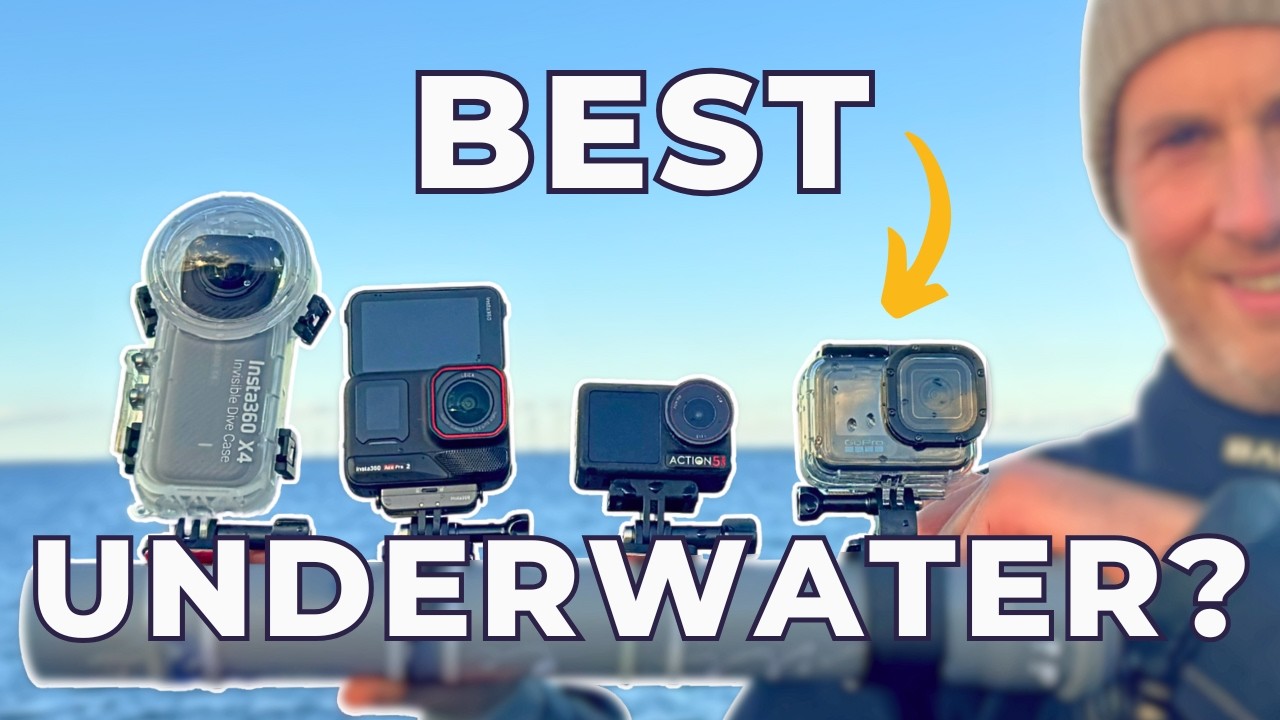


Over 15 years of diving, the DIVEIN team has shot thousands of hours of underwater footage across coral reefs, wrecks, and open ocean. We have tested every major action camera released in the last five years, taking each one on real dives to evaluate image quality, color accuracy, stabilization, and depth performance firsthand.
For 2026, we narrowed our picks to six cameras: Insta360 Ace Pro 2, DJI Osmo Action 5 Pro, Insta360 X5, GoPro HERO13 Black, and Insta360 GO 3S. Whether you are a snorkeler looking for your first underwater camera or a certified diver who wants a compact backup to a housed system, this guide covers what matters most below the surface.


How to Choose an Underwater Action Camera
Choosing an underwater action camera isn’t the same as picking one for land use. Water reduces light, shifts colors, and introduces constant motion from currents and buoyancy changes. In our testing, cameras that perform well on land don’t always hold up once you’re below the surface.
Here’s what actually matters when diving.
Depth Rating and Housing
Most action cameras are waterproof out of the box to around 10m. That’s fine for snorkeling, but not enough for scuba diving.
For anything deeper, you’ll need a dedicated dive housing, typically rated to 30–60m.
What to look for:
- Clearly rated depth (not just “waterproof”)
- Reliable button operation at depth
- Large, glove-friendly controls
- Anti-fog inserts or compatibility
If you plan to scuba dive regularly, treat a housing as mandatory—not optional.
Battery Life Underwater
Battery life drops faster underwater, especially in cold conditions.
While many cameras claim 90–120 minutes of runtime, real-world dive use is often shorter due to:
- cold water
- continuous recording
- stabilization processing
In our experience, a single battery rarely covers a full dive day.
What to prioritize:
- At least 60–90 minutes real-world runtime per battery
- Swappable batteries for surface intervals
- USB-C fast charging between dives
For dive trips, plan on carrying 2–3 spare batteries minimum.
Stabilization Technology
Underwater footage is naturally unstable. Even experienced divers introduce small movements with every breath and fin kick.
Modern cameras rely on electronic stabilization systems like:
- GoPro HyperSmooth
- DJI RockSteady / HorizonSteady
These systems dramatically improve footage, especially in surge or current.
What matters most:
- Horizon leveling (keeps footage straight)
- Strong performance in low light (some systems degrade at depth)
In testing, stabilization is one of the biggest differences between budget and premium cameras.
Image Quality and Low-Light Performance
Water absorbs light quickly. By the time you reach recreational dive depths, colors are heavily muted and scenes are darker.
This is where sensor quality matters.
Higher-end cameras:
- capture more available light
- reduce noise and grain
- preserve more usable color data
This becomes critical for:
- dives below ~10–15m
- wrecks and overhead environments
- early morning or low-visibility conditions
Even with a good camera, most divers will benefit from:
- video lights for true color restoration
- red or magenta filters for natural tones
Mounting and Accessories Ecosystem
The camera itself is only part of the setup. Accessories make a huge difference underwater.
The strongest ecosystems (GoPro, DJI) offer:
- dive housings
- trays and dual-handle rigs
- external video lights
- color filters
- mounting options for masks, wrists, and BCDs
In practice, this determines how far you can grow your setup over time.
A limited accessory ecosystem can quickly become a bottleneck as you progress.
Ease of Use Underwater
Controls that feel fine on land can be frustrating underwater.
When diving, you’re dealing with:
- gloves
- limited visibility
- task loading
Look for:
- large, tactile buttons
- simple, intuitive menus
- quick start/record functionality
Touchscreens are useful on the surface, but physical buttons matter more underwater.
Use Cases by Dive Type
Different types of diving place different demands on your camera.
Snorkeling (0–10m)
- No housing usually required
- Compact size and simplicity matter most
- Budget models perform well
Scuba Diving (10–40m)
- Requires dive housing
- Stabilization and low-light performance become critical
- Mounting system (tray + lights) makes a big difference
Freediving
- Lightweight, low-drag setup is key
- Fast startup and reliable auto exposure matter
- Depth rating still important depending on discipline
Choosing based on your primary use case will narrow down options quickly.
Budget Tiers
Underwater action cameras fall into three clear categories:
Budget ($50–$150)
- Basic 4K capability
- Includes housing
- Weaker stabilization and low-light performance
- Best for casual snorkeling or occasional use
Mid-Range ($200–$350)
- Older GoPro or DJI models
- Strong stabilization and solid image quality
- Best value for most divers
Premium ($400+)
- Latest GoPro, DJI, Insta360 models
- Best stabilization, sensors, and features
- Ideal for frequent divers and content creation
For scuba diving, mid-range is usually the minimum worthwhile investment.
Smartphone Housing vs Action Camera
Many beginners consider using their phone with a waterproof housing instead of buying an action camera.
Smartphone Housing
Pros:
- Uses a device you already own
- Strong still photo quality
- Easy editing and sharing
Cons:
- Bulky underwater
- Higher flood risk
- Limited mounting options
- Difficult to handle with gloves
Action Camera
Pros:
- Compact and durable
- Designed for underwater video
- Wide accessory ecosystem
- Easy to mount and stabilize
Cons:
- Smaller sensors for photos
- Requires additional accessories for best results
Bottom line:
For occasional use, a smartphone housing can work. For regular diving, an action camera is the more practical and reliable setup.
Final Take
The best underwater camera isn’t just about resolution—it’s about how well the system performs in real dive conditions.
In our testing, the biggest differences come down to:
- stabilization
- low-light performance
- battery reliability
- and the available accessory ecosystem
If you focus on those four areas, you’ll end up with a setup that actually delivers underwater—not just on paper.
The best underwater action camera depends on your needs. For top image quality and stabilization, premium models from brands like DJI and GoPro are strong choices. If you want immersive footage, a 360° camera like the Insta360 X5 is ideal. Budget options can still deliver solid 4K video. The right camera comes down to your diving style, budget, and preferred features.
Most action cameras are waterproof to 33–60 feet (10–18 meters) without a housing. This is fine for snorkeling, but not for scuba diving. For deeper dives, you’ll need a dive housing rated to at least 100–130 feet (30–40 meters).
Yes. The GoPro HERO13 is waterproof to about 33 feet (10 meters), which isn’t deep enough for scuba diving. A dive housing is required for deeper dives and adds extra protection underwater.
The best budget underwater action cameras offer 4K video, basic stabilization, and a waterproof housing. Models like the Akaso Brave series are popular for entry-level use, though they don’t match the image quality of premium cameras.
Yes, you can use your phone underwater with a quality waterproof housing. Phones can be great for casual photos and video, especially if you already like your phone’s camera system. Action cameras are usually better for mounting, hands-free recording, and fast-moving footage, while phones can be a good fit for divers who want a more familiar shooting experience.
Look for at least 4K at 60fps. This delivers sharp, smooth underwater footage. Higher resolutions like 5.3K or 8K are useful for editing and cropping but aren’t essential for most divers.
To improve color in underwater footage, use a red or magenta filter to restore warm tones, especially in blue water. Setting a manual white balance (if your camera allows it) can also help achieve more natural colors. For deeper dives, adding underwater video lights brings back lost color and contrast. You can further enhance your footage by adjusting color during post-production.
The DJI Osmo Action 5 and GoPro HERO13 are both strong underwater action cameras. DJI typically offers better battery life and dynamic range, while GoPro has a larger accessory ecosystem. The better choice depends on whether you prioritize performance or versatility.
 Take a moment to look at this.