




Prescription dive masks vary widely in real-world performance, and not all models deliver the same clarity, fit, or optical accuracy underwater. Differences in lens type, diopter precision, and mask design can significantly impact vision, comfort, and how easily you can read gauges or focus on marine life at different distances.
At DIVEIN, our team has more than 20 years of experience diving with corrective lenses and tested each prescription dive mask in this guide in real open water conditions. We evaluated optical clarity using an underwater eye chart across different lens types and diopter strengths, along with fit, field of view, and overall usability. Based on this hands-on testing, we selected the best prescription dive masks for 2026 and included a detailed guide to help you choose and order the right setup for your vision needs.
Best Prescription Dive Masks We Tested


Why Trust Us
All of the divers and writers at DIVEIN are enthusiastic about gear. Our track record of testing and reviewing with objectivity is well established. For this guide, we enlisted the advice of an ophthalmologist (who happens to be the main author’s father). More importantly, we’ve actually used all the prescription dive masks reviewed and included in this curated list.

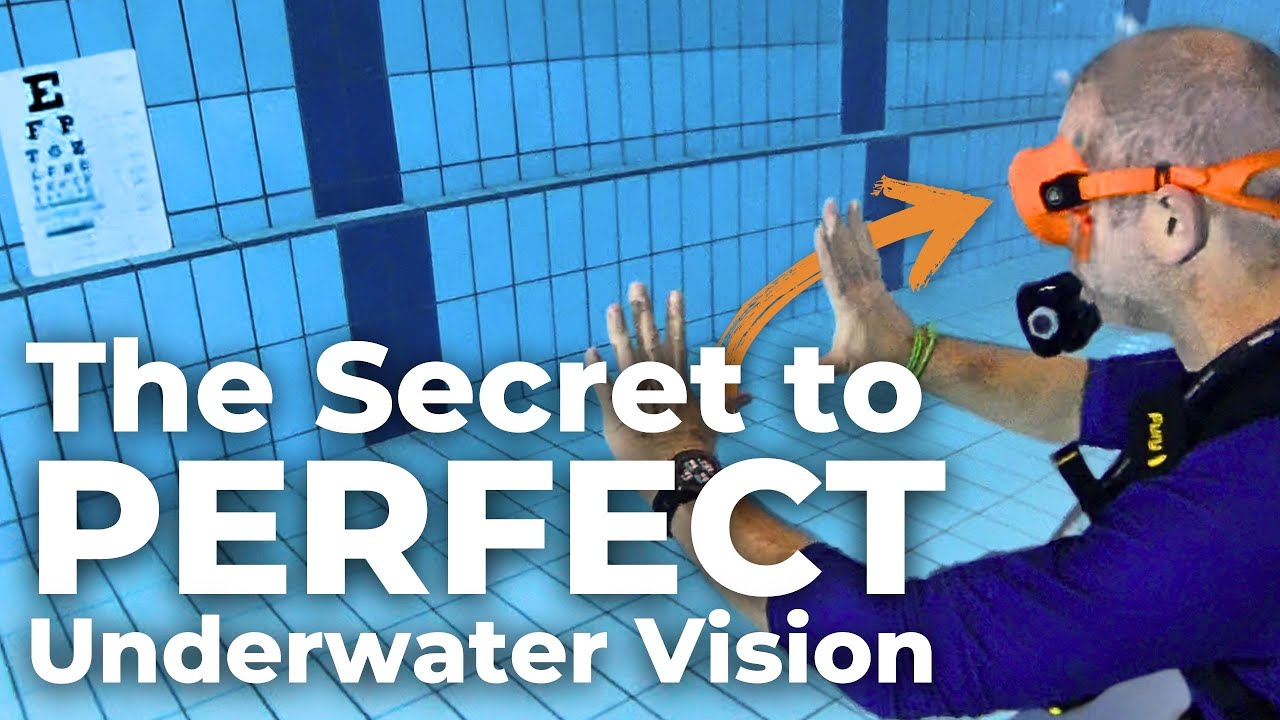
In addition to in-ocean experience, and to ensure the best possible conclusions, the author also completed a visual acuity test (an eye chart) underwater to assess the clarity of corrective lenses in the different mask options.
It’s important to stress that no prescription lens option will be good unless the dive mask itself is great.
Understanding vision problems for divers: nearsightedness, farsightedness, and bifocals
Divers can experience a range of vision issues underwater. The most common are nearsightedness (myopia) and farsightedness (hyperopia).
The trick to remember while diving is to know that you’ll need to focus on the near, the far, and the space in between in order to both read your gauges and see your surroundings.
It’s necessary to change the shape of the eye to switch focus from near to far and back again. This is called accommodation. For example, I can read without glasses, therefore I’m nearsighted. I can see the near, not the far without Rx (corrective) lenses.
But using corrective lenses to see far inhibits my ability to see my dive computer. This is where bifocals come into play, providing essentially two lenses to accommodate the near and far, respectively. To find the proper prescription diving mask, you must understand how your eyes work.
For nearsighted masks
In simple terms, if you need glasses for driving or watching TV but not for reading you’re nearsighted or have myopia. Nearsighted people can see objects up close but have trouble seeing things far away. Underwater, this can make it difficult to spot distant sea life, stay with a group, or navigate properly.
Prescription lenses for myopia usually range from -1.0 to -10.0 diopters. You can order them online for as little as $75, depending on the quality of the mask itself.
The below image shows a “Plus” insert made by Cressi, specifically for its Focus masks. See how the diopter (strength) can be chosen from -1.0 to -7.0.

For farsighted masks
If you use a pair of readers for the computer or a book but see objects clearly at 10 feet (3 meters) and beyond, you’re farsighted or have hyperopia. Without reading glasses, objects up close appear blurry.
Farsighted divers struggle to see things close up, like gauges or dive computers. This can be a significant problem when trying to read underwater.
Corrective lenses for hyperopia (often called readers) range from +1.0 to +8.0 diopters. Gauge reading inserts (below) can be purchased for as little as $25 or, for specific lenses made to match a specific mask, a little more.

Bifocal needs
Some divers require correction for both distance and close-up vision. A bifocal scuba mask can address this. The top part of the lens corrects for distance, while the bottom portion is for reading gauges.
Online sellers of prescription scuba masks will sometimes list bifocals as simply having corrective lenses in one half of the field of view and no power in the other.
In the image below, two prescription masks show different-sized lenses that have been bonded into a mask. Both have been custom-made for my myopia (nearsightedness), but the lens in the orange mask covers the whole field of view, whereas the black mask has a “bifocal” effect by allowing my eyes to scan downward without any diopter or strength.
True bifocals—with nearsighted lenses up top and farsighted lenses below—can be made by a few specialized companies at a higher price. Unfortunately, for those with a complex Rx, this is a necessary cost.
For those diving a lot, including cameramen, YouTubers or scuba addicts, this is the price of clarity and escape from dealing with contacts. A custom-made, proper bifocal mask will run north of $350 for the mask and the bonded lenses.
Types of prescription dive masks
When shopping for a dive mask with prescription lenses, you have several options:
Single vision prescription masks
These masks are designed for either nearsightedness or farsightedness. They are ideal if you only need correction for one type of vision problem.
Bifocal prescription masks
These masks feature bifocal lenses, with different diopter strengths for distance and close-up vision. This type of mask is perfect for divers who need both myopia and hyperopia correction.
Custom prescription masks
If your prescription is complex or doesn’t fit standard ranges, custom-made masks are available. They offer precise correction based on your exact needs.
Key features to consider when choosing a prescription scuba mask
Selecting the right corrective scuba mask involves more than just the lenses. Here’s what else you should consider.
Lens compatibility
Decide between single-lens and double-lens mask designs. Double-lens masks usually offer more flexibility for prescription options.
Material quality
Look for masks made of high-quality silicone and tempered glass. These materials ensure durability, comfort, and a better seal against water leaks.
Fit and comfort
A good mask should fit snugly without feeling tight. Check for an adjustable strap system and a soft, well-fitted silicone skirt that seals comfortably around your face.
Lens installation
Some masks come with removable prescription lenses that you can swap out as needed. Others have integrated lenses, which may be more durable but less flexible for updates.
How to order the right prescription snorkel or dive mask
Ordering the correct prescription scuba mask involves a few important steps. I use a few different masks with different prescriptions, because my Rx is not that complicated.
While I have better masks with the proper correction for astigmatism in the lenses for crisp vision, I also have two inexpensive masks with simpler prescriptions. I use them for snorkeling, casual swimming, and as backups when I go on holiday.
Understand your prescription
Know your SPH (spherical) and CYL (cylinder) values. These measurements determine how your lenses will correct your vision.
Your optician or eye doctor may have given this information to you. Otherwise, it’s easy to get a vision test by walk-in or by appointment at an optical store selling glasses. You can get it for free sometimes. Snap a picture of it on the computer screen.
Measure your pupillary distance (PD):
Accurate PD measurement ensures your lenses are aligned correctly with your eyes. You can measure this at home or get it from your optician.
To measure your PD:
- Place a ruler up against your face above your eyes while looking in a mirror.
- Align the end of the ruler–where the “0” value is–at the middle of one pupil and close that eye
- Measure in millimeters to the middle of the other pupil.
The value will be somewhere between 50mm to 80mm. The average adult PD is 65mm. Keep in mind you might get two PD values. Just add them together in that case

Choose between pre-made lenses and custom lenses
Pre-made corrective lenses are available for common prescriptions and are more affordable. Custom lenses provide precise correction, especially if you have an unusual prescription.
This is where price swings from reasonable to suddenly quite expensive. For most vision-impaired divers with simple prescriptions, pre-made lenses will be more affordable and can get the job done.
Choose a reliable retailer or brand
Many reputable brands, like TUSA, Cressi, and ScubaPro, offer lenses suited to their specific masks.
While stick-on lenses are available online at retailers like Amazon, we recommend them only for simple gauge reading requirements.
Caring for your prescription dive mask
Proper care is vital to keeping your corrective scuba mask in good condition. Here’s how to extend its life.
Clean the lenses regularly
Rinse your mask with fresh water after every dive. Use a soft cloth to avoid scratching the lenses.
Use defogging solutions
A good defogging spray or gel prevents your mask from fogging underwater. A gentle solution will also prevent rough, abrasive treatment of the glass and save it from any scratches. Spitting is always going to be the go-to when out in the water. Don’t be afraid to do the same with your corrective lenses. You can also use homemade remedies like a dab of baby shampoo.
Store the mask properly
Keep your mask in a protective case when not in use. At the very least, wrap it up in a soft cloth. This prevents scratches and extends the mask’s life.
Final views on seeing clearly
A prescription diving mask can greatly enhance your underwater experience. Clear vision makes diving safer and more enjoyable. Whether you’re nearsighted, farsighted, or need bifocal correction, there’s a solution out there.
Investing in a high-quality, well-fitting corrective scuba mask is worth it. By following this guide, you’ll be equipped to choose the right mask that meets your vision needs and fits your budget.
Enjoy your next dive with crystal-clear underwater views!
Prescription mask FAQs
Yes, you can get a prescription dive mask for astigmatism, but it typically requires custom lenses. Pre-made prescription dive mask lenses only correct basic near- or far-sightedness. If you have astigmatism, you will need custom-ground lenses that match your full prescription, including cylinder and axis values. Most dive shops or optical providers can install these lenses into compatible masks.
A prescription dive mask typically costs between $80 and $300 or more. Basic masks with pre-made lenses are the most affordable option. Custom prescription lenses increase the price depending on your vision needs, especially for astigmatism or bifocals. In most cases, the cost of the mask and the lenses are separate.
Yes, you can wear contact lenses while scuba diving, and many divers do. Soft contact lenses are preferred because they are less likely to cause issues underwater. Daily disposable lenses are a good option in case one is lost. However, a prescription dive mask provides more reliable vision and eliminates the risk of losing a lens during a dive.
Pre-made prescription dive mask lenses come in fixed diopter strengths and are designed for quick, affordable vision correction. They are ideal for common prescriptions. Custom prescription lenses are made to match your exact vision, including astigmatism and more complex corrections. They offer better clarity but are more expensive and may take longer to produce.
Yes, prescription dive masks work for both scuba diving and snorkeling. They improve underwater visibility in any situation where you need a mask. Whether you are snorkeling on the surface or diving deeper, a properly fitted prescription mask provides clear, consistent vision.
Pupillary distance (PD) is the distance between your pupils and is required for custom prescription lenses. The most accurate way to get your PD is from your optometrist during an eye exam. You can measure it at home with a ruler and mirror, but even small errors can affect lens alignment and clarity underwater.
Yes, many prescription dive masks offer bifocal lenses or reader inserts, which help you see gauges and dive computers clearly. Progressive lenses are less common due to mask design limitations, but some custom options are available. Most divers choose bifocals for simplicity and reliability.
Prescription dive mask lenses can last for many years without losing effectiveness. The lenses themselves are durable, but the mask skirt and straps will wear out over time. Proper care, including rinsing with fresh water and storing away from sunlight, will extend the life of your prescription dive mask.
 Take a moment to look at this.



Thank you for posting this and sharing your insights. This helps me to decide well.
Hi ilm after a good Quality mask with prescription lenses fitted.
Right eye Plano sphere with a cylinder of – 4 & an axis of 1.
Left eye ” ” ” ” ” ” – 4.75 & an axis of 5
Depending on where you are in the world, the prescription-dive-mask.com option will match your prescription best, especially if you want to correct for the astigmatism. I’m not an optometrist, but you can reach out to those guys, as they have one on staff. For me, I’ve a slight astigmatism and have also been satisfied (to a lesser degree maybe) with simple -1.5 & -1.0, even though I have a -1.5 & -1.25. That’s where the less expensive mask at the top makes a great extra prescription scuba mask.
Hi Diane,
Oh no, it’s the worst way to end a dive buy dropping the most important piece of gear.
For a replacement, and if you’re looking for a more personal approach, you can visit prescriptiondivemasks.com they also have a physical shop.
Thanks good article. In May 2018 I purchased Palantic Bifocal Black gauge reader mask for farsighted power +2.00 I purchased through Amazon and going back in history I have found the purchase but unable to “buy again “ :(. I really liked the cause I know the fit,,,so while finally getting in the water at a quarry not far from home I lost my mask and because I am not computer literate ,so it seems, can’t find the replacement or a site to make contact with a human to put in an order. I am going diving ,I hope, in Dec.
since I read this article I thought I would reach out to see if you had a reliable connection ,or at least would answer me back.
I need a bifocal type ,I thought I’d go to +2.50 this time ,no prescription yet because eyes are still changing.
I do hope to get words back from you, thanks.
Thank you
Do they make masks up to -18?
Do they make a progressive scuba mask like they make progressive lens? I am farsighted and I have a mask with bifocals 1.5 correction but having some difficulty with reading my compass when I am holding it in front of me. Suggestions?
I have an atomic dive mask i didnt like the prescription was made it was a piece of lense that was attached to the mask lense
it was badly done can this mask be turned into better prescription dive mask?
Is there anywhere in the UK that offers custom prescription masks?
Yes, or at least it was possible at some point, not sure if it still is.
Can scubapro crystal vu masks be made with prescription lenses?
Looking for astigmatisms correction as well. What would you recommend?
Tqvm ! The article helped me a lot .